
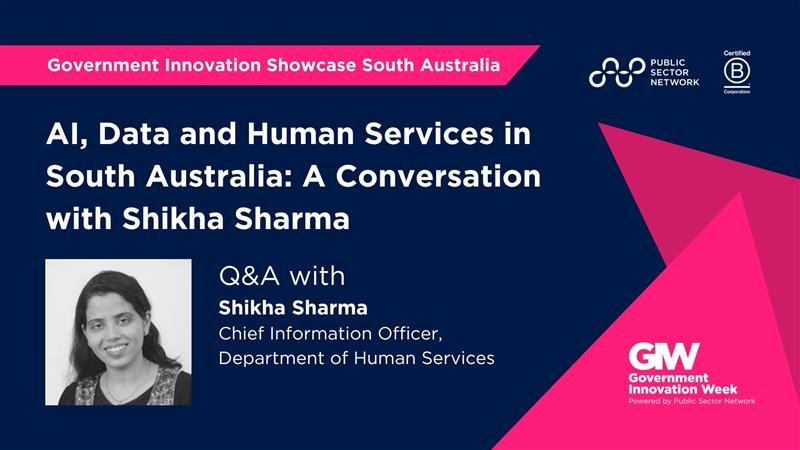
As governments look to scale AI beyond pilot programs, human services leaders face a unique challenge: how to unlock the value of data and emerging technology while protecting trust, privacy and fairness. In this Q&A, Shikha Sharma, Chief Information Officer, Department of Human Services, shares her perspective on the biggest near-term opportunities for AI, the quick wins agencies can act on now, and the data and governance foundations that must be in place before AI can scale safely in sensitive, people-centred services.
At Government Innovation Showcase South Australia 2026, Shikha will join the panel “AI, Data and Tech in Social and Community Services,” which will explore data-sharing models, frontline tools, ethical AI, and the role of digital investment in improving outcomes for families and vulnerable cohorts
Public Sector Network:
What do you see as the biggest opportunities for AI, data and emerging technology in human services over the next 12 to 24 months?
Shikha Sharma:
Over the next 12 to 24 months, the biggest opportunity is using AI to reduce administrative burden and improve decision quality, so frontline staff can spend more time with people and less time with paperwork. Practically, that includes secure transcription and summarisation of case notes, turning unstructured notes into structured actions, and using thematic analysis to identify recurring drivers of risk and demand.
A second opportunity is using AI to help staff quickly find the right policy, guideline or process, and produce more consistent drafts for briefs, referrals and communications. Third, we can use AI to support more equitable policy and program design, for example by assisting impact assessments so inclusion considerations are embedded earlier and more consistently, rather than treated as an afterthought.
Hear Shikha Sharma at Government Innovation Showcase South Australia 2026 in the panel discussion “AI, Data and Tech in Social and Community Services”, taking place at 12:20 PM on Wednesday, 10 June 2026. The session will examine new data-sharing models, frontline tools, ethical AI in social care, and the $14.9 million Digital Investment Fund investment aimed at improving how information about families facing complex issues is managed.
Register here: https://psnevents.eventsair.com/government-innovation-showcase-south-australia-2026/gov/Site/Register
View the agenda: https://publicsectornetwork.com/events/government-innovation-week-south-australia-adelaide-2026/government-innovation-showcase-south-australia-adelaide-2026/speakers/
Public Sector Network:
What practical quick wins can agencies pursue now, and where is longer-term reform still needed?
Shikha Sharma:
The quick wins are the use cases that sit above existing systems and data, where we can improve productivity without re-engineering everything.
That includes:
- summarising and drafting briefs, emails, meeting notes and policy summaries, with clear human approval
- search and retrieval over non-sensitive corporate knowledge to cut time spent hunting for the right information
- targeted workflow automation where processes are already stable, using AI to capture actions, standardise records and improve consistency
Where longer-term reform is needed is anything that depends on connected, reliable data across services. That is where the focus needs to be on building a modern data platform, an enterprise data warehouse, and an integration layer so information can be reused safely rather than rebuilt repeatedly.
This is also where we need to invest in data definitions, quality, metadata, lineage and governance, because scaling AI without those foundations just scales inconsistency and risk.
Public Sector Network:
What are the biggest risks or considerations when applying AI and data in sensitive, human-centred services?
Shikha Sharma:
In human services, the first consideration is privacy and security, because many datasets are identifiable and cannot simply be de-identified without losing meaning. That is why strong controls matter, including secure environments, clear access controls, auditability, and risk-appropriate assessments before anything goes live.
Second is accuracy and over-reliance. AI should be used to draft, summarise or highlight themes, but people remain responsible for decisions and records. Third is bias and fairness. If historical data reflects structural inequities, models can reproduce them, so leaders need explicit testing, transparency about limitations, and the ability to contest decisions.
Finally, there is trust and legitimacy. Clear ethical guidance, assurance frameworks and strong governance are essential to keep innovation aligned with rights, safety and community confidence.
Public Sector Network:
What does good data maturity look like, and what foundations should agencies prioritise before scaling AI?
Shikha Sharma:
Good data maturity means moving from data-informed, to data-driven, to data-led, where data first provides visibility, then supports value through scalable insights, and eventually enables more automated decision support with appropriate controls.
Before scaling AI, I would prioritise:
- business ownership of data, including definitions, fit-for-purpose quality and accountability
- governance and classification so sensitive data is handled correctly and consistently
- common definitions and data quality routines, so the same metric means the same thing across programs
- metadata and lineage so people can discover and trust where data came from and how it changed
- modern platforms and integration patterns so agencies stop rebuilding bespoke pipelines and can reuse data safely
Public Sector Network:
What is one key takeaway you hope attendees leave with after Government Innovation Showcase South Australia?
Shikha Sharma:
We are no longer asking whether AI can work, because we already have enough evidence that it can. The real question now is how we scale it safely, consistently and in a way that delivers sustained public value.
That means shifting from isolated pilots to enterprise-grade capability by embedding AI into core business processes, supported by modern data platforms, strong governance and clear accountability.
This is a joint responsibility between service owners and CIO and CDO functions. Service owners must own outcomes and day-to-day usage, while CIO and CDO teams ensure that the platforms, data and controls are industrialised and sustainable.
Join Shikha Sharma at Government Innovation Showcase South Australia 2026 to hear more on how agencies can move from isolated AI pilots to scalable, trusted capability in social and community services. Shikha’s panel will bring together leaders from the Department for Child Protection, Department of Human Services, and Women’s and Children’s Health Network to discuss practical approaches to data sharing, frontline enablement, and responsible AI.
Register here: https://psnevents.eventsair.com/government-innovation-showcase-south-australia-2026/gov/Site/Register
View the agenda: https://publicsectornetwork.com/events/government-innovation-week-south-australia-adelaide-2026/government-innovation-showcase-south-australia-adelaide-2026/speakers/






Help your peers
Share what you've learned with fellow public servants