

Most organisations are repeating the same mistake with AI agents that they made with APIs and integrations — putting governance off until it’s too late. With AI agents, that procrastination is far more dangerous, and far harder to remediate.
AI agents are one of the most consequential shifts enterprises are facing since the web and cloud revolutions. They affect organisations of every size, in every geography, across every industry. And almost everywhere that conversation is happening, the same question keeps surfacing: how do we minimise the risks associated with AI agents, that is, how do we “govern” them?
Through late 2024 and early 2025, the approach to AI agents was experimental — pilots and proofs of concept, fostered by the excitement of a new and powerful technology. By late 2025 and into 2026, the mood changed. Boards and executive teams stopped asking CIOs and AI leaders to explore the technology and started asking them to deliver business outcomes. The mantra became “move from PoC to production.”
That shift moved the hard questions to the foreground. Not “what can this technology do?” but “how do we run it safely and reliably at scale?” How do we deploy, monitor and manage large fleets of agents across our organisation? How do we enforce security and compliance policies? How do we monitor what agents are actually doing, and keep costs under control? Collectively, the answers to these questions are what we mean by AI agent governance: the technology-enabled rules, practices and processes needed to direct and control agentic AI initiatives across the enterprise.
The Afterthought Trap
Here is the pattern we’ve seen play out repeatedly in enterprise technology: governance gets treated as something to deal with later. When you only have a handful of assets (say APIs) to manage, informal oversight feels good enough. Formal governance only arrives once the sprawl becomes unmanageable.
That attitude is already a poor practice in disciplines such as APIs, application and data integration or enterprise applications. With AI agents, it’s genuinely dangerous.
Agents are autonomous or semi-autonomous by design. Even a small number of them carries real risk. An agent can leak sensitive data or breach a compliance rule without anyone instructing it to. Moreover, AI agents tend to quickly proliferate. SaaS vendors ship pre-packaged agents inside their products. “No-code agent builder” tools put agent creation in the hands of business teams. The result is agent sprawl: fast, decentralised, wildfire AI agent adoption that compounds risk in ways that are hard to anticipate and harder to trace.
The critical point: it is far harder to impose governance after a number of agents have spread across the organization than to build it in from the start. Retrofitting controls onto a sprawling fleet is organisationally fraught, technically expensive, and demands political capital from leadership that earlier action would never have required.
Which leads to the one consolidated best practice in this space:
Establish governance at the very earliest stages of your AI agent initiative. This is a proactive posture that requires commitment and a clear, unequivocally accountable responsibility.
What “Governance” Actually Means
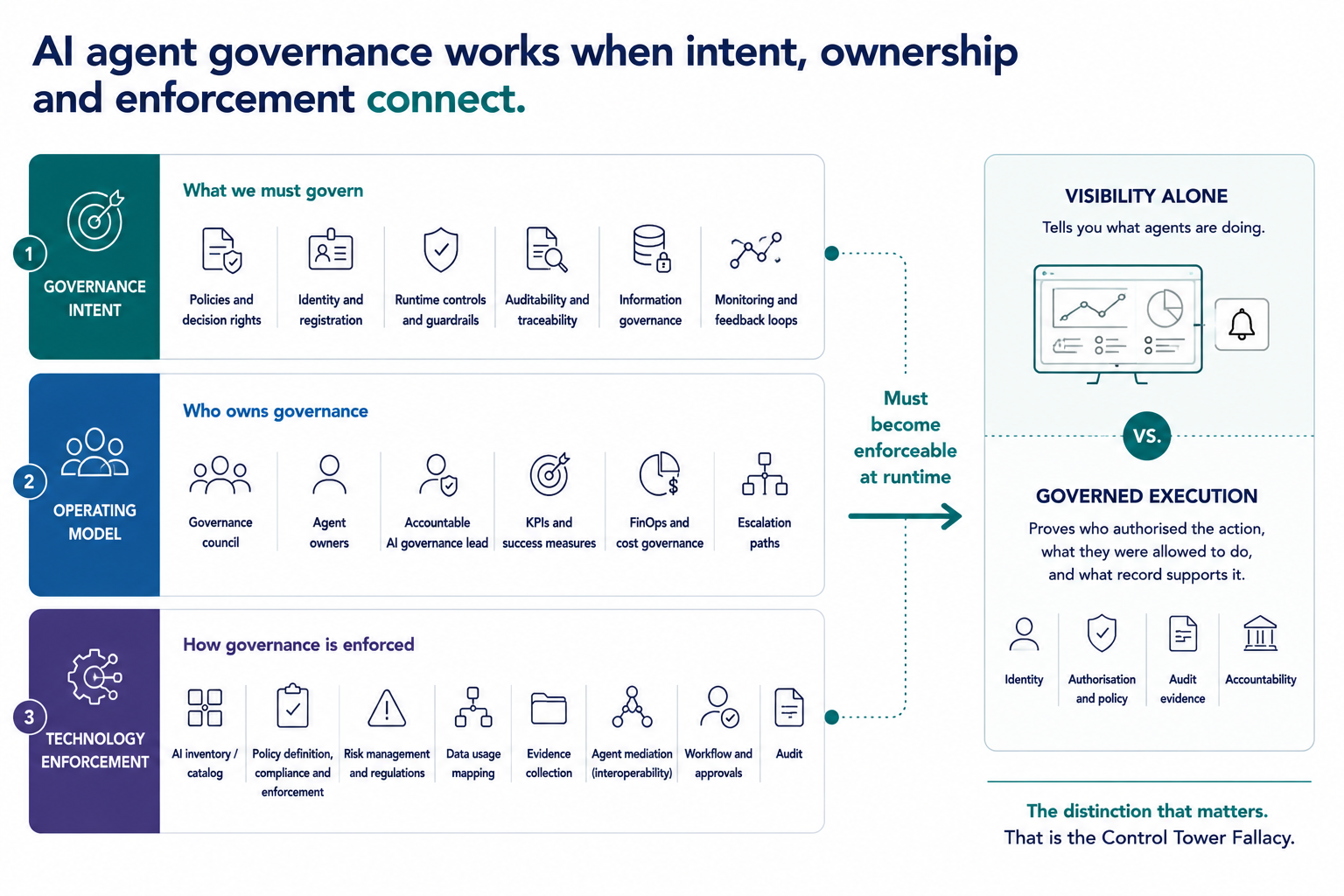
So what are we precisely referring to? In practice, agentic AI governance can be broken into two halves — the organisational capabilities you put in place, and the technology capabilities that enforce them. And there’s a third element that’s easy to overlook: the gap between the two, where most governance programmes quietly fail.
The ultimate goal is simple to state, a lot less to achieve: make AI agents safely operate across the organisation: accountable, observable, auditable, and constrained to operate within your processes, policies and compliance requirements.
Start pragmatically, but don’t water it down
This is a broad and complex set of capabilities, and you shouldn’t try to stand all of it up on day one. That would be demanding and expensive, and it forces a steep learning curve before you’ve earned any return. An incremental, pragmatic approach is the preferrable one — build governance in step with the maturity of your agentic AI programme.
But “incremental” is not “optional.” The risk of a phased approach is that commitment erodes, corners get cut, and you end up with bare-minimum governance that satisfies a checklist and protects no one. Avoiding that outcome takes sustained leadership. The end-game is a complete governance platform — organisational and technological — fully operational on a timeline that keeps pace with your agentic AI rollout, not one that trails permanently behind it.
That’s exactly the distinction we explore in our whitepaper, The Control Tower Fallacy. Why focusing only on the visible, easy-to-justify capabilities leaves a dangerous gap, and the questions senior leaders should be asking before agent sprawl makes those questions much harder to answer.

Published by
About our partner
Workato
Workato is the leading Enterprise Control and Execution Platform for AI, the neutral platform enterprises trust to put AI to work across their business. Workato connects AI to the systems, data and processes it needs to reason accurately and augment human service delivery. That’s what turns isolated AI tools into governed, connected intelligence, and turns skilled people into superhumans. Built on more than a decade of running mission-critical processes for over half the Fortune 500 and leading Australian enterprises and Federal and State government Departments and agencies, Workato turns over 14,000 enterprise systems AI needs to act on into one governed execution layer. Workato is IRAP assessed to PROTECTED, and holds ISO 27001 and ISO 27701 certification, giving Australian Government agencies the governed, auditable and secure foundation needed for agentic readiness, with complete data sovereignty within Australia. Recognised as a Leader in the Gartner® Magic Quadrant™ for Integration Platform as a Service for eight consecutive years, and validated by Gartner as a natural AI Execution and Control Plane for the enterprise, Workato is the strategic layer government agencies need to connect every app, automate every workflow and power every AI agent. For more information, visit workato.com
Learn more




Help your peers
Share what you've learned with fellow public servants