
Across five roadshow stops (Adelaide, Perth, Brisbane, Melbourne, Sydney), local government leaders were clear on the core tension: rising service expectations and ageing assets, under tighter financial constraints.
The polling shows councils are not standing still. Many are planning transformation, most are exploring AI, and almost everyone sees productivity uplift as part of the answer. The gap is confidence and readiness, especially on cyber resilience.
The headline pressures (national picture)
Budget and financial sustainability is the immediate pain point.
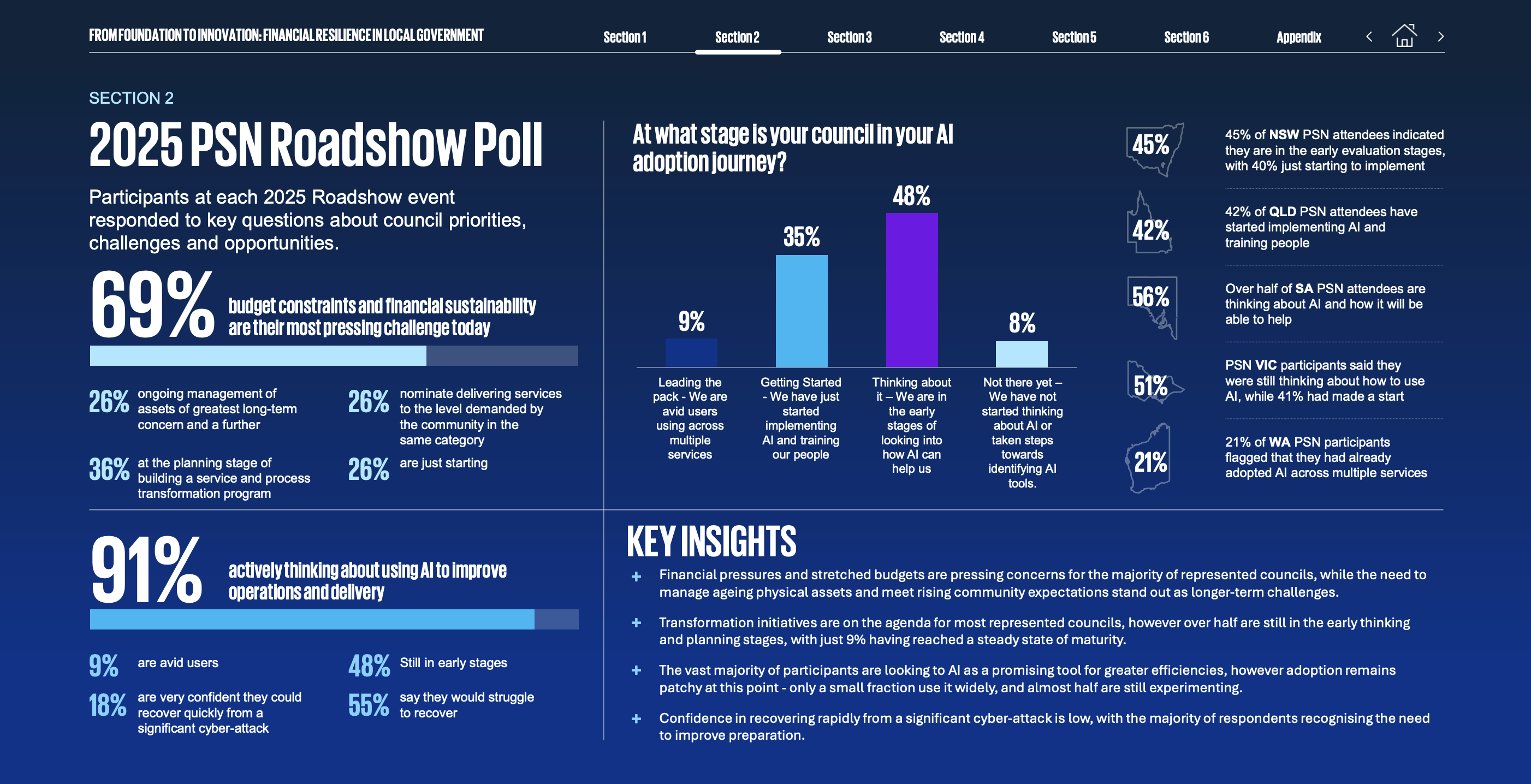
- 69% nominated budget constraints and financial sustainability as the most pressing challenge today.
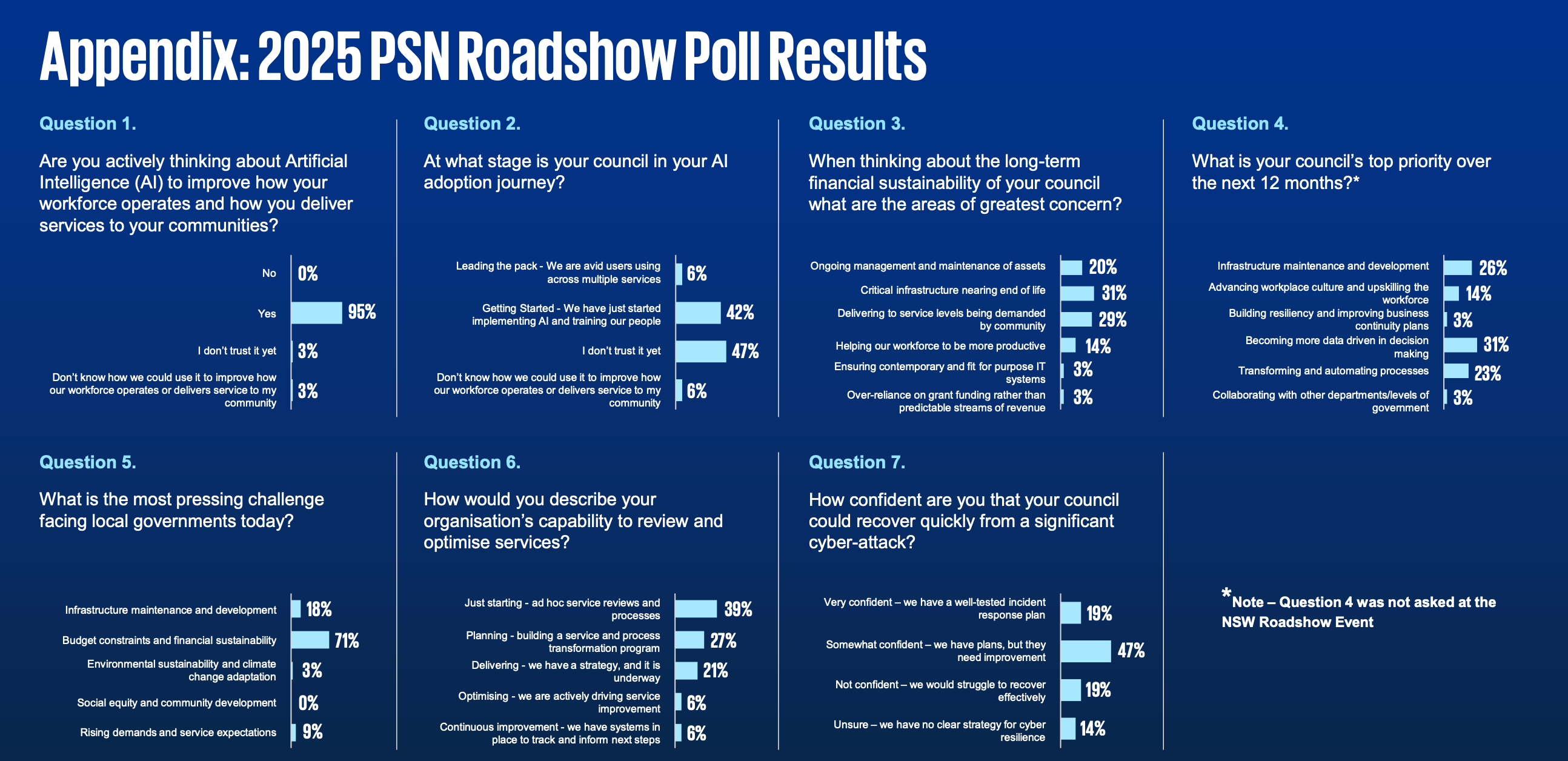
- Next most-cited challenges were rising demands and service expectations (16%) and infrastructure maintenance and development (10%).
Long-term financial sustainability concerns are split between assets and service levels.
- The two equal “top concerns” called out were:
- Ongoing management and maintenance of assets (26%)
- Delivering services to the level demanded by the community (26%)
This combination is important: councils are not just worried about the balance sheet. They are worried about maintaining service credibility while infrastructure and operating costs keep rising.
Transformation maturity: lots of intent, limited “steady state”
Councils are working on service and process transformation, but the polling suggests many are still building the base.
- 36% are at the planning stage of building a service and process transformation program.[1]
- Only 9% reported reaching a mature, steady-state level of transformation/continuous improvement in the roadshow highlights.
Why that matters: the strongest productivity gains from technology tend to come when process, data, and operating rhythm are already disciplined. The “planning majority” is a signal that councils need practical pathways, not big-bang programs.
AI: near-universal interest, but adoption is uneven (and very state-shaped)
Interest is overwhelming.
But most are still early.
- AI adoption journey (overall):
- 9% “leading the pack” (avid users across multiple services)
- 35% “getting started” (implementing and training people)
- 48% “thinking about it” (early evaluation)
- 8% “not there yet”
State comparisons (AI adoption stage)
The strongest state-level signal in the report is that councils are not moving at the same pace:
- NSW: 45% in early evaluation, 40% just starting to implement.
- QLD: 42% have started implementing and training people.
- SA: 56% are still “thinking about AI” and how it could help.
- VIC: 51% still thinking, 41% had made a start.
- WA: 21% reported they had already adopted AI across multiple services (the highest “leading the pack” figure called out by state).
PSN takeaway: the opportunity is not “AI, broadly.” The opportunity is to meet councils where they are:
- For early-stage states, focus on use case selection, probity-safe governance, and workforce readiness.
- For more advanced pockets, focus on scaling, cross-service reuse, and measuring benefits.
Cyber resilience: confidence is low, risk exposure is widely acknowledged
Councils see cyber as a trust issue as much as a technical one, and the polling suggests many do not feel ready.
- Only 18% said they are very confident they could recover quickly from a significant cyber-attack.
- 55% said they would struggle to recover (roadshow highlight framing).
PSN takeaway: as councils digitise and introduce AI, cyber resilience becomes a prerequisite for service continuity and public confidence, not a separate workstream.
What councils said they will prioritise next (next 12 months)
When asked about next-year priorities (note: Question 4 was not asked at the NSW stop):
- Transforming and automating processes: 23%
- Other priorities included helping the workforce be more productive, and ensuring contemporary, fit-for-purpose IT systems (both shown in the appendix results list).
This points to a pragmatic agenda: councils want productivity and process outcomes, not transformation theatre.
The PSN lens: what this means for the sector right now
Three consistent themes came through the polling and discussions:
- Financial resilience is now a delivery issue. Cost pressure and constrained revenues are directly shaping service levels and asset decisions.
- AI is on the table almost everywhere, but readiness is uneven. The state comparisons show different starting points, which means different support needs.
- Cyber confidence is a red flag. Digital uplift without resilience planning increases operational and reputational risk.
For the full context, practical tips, and the complete poll appendix, use this pre-read as your guide, then go to the full KPMG report.





Help your peers
Share what you've learned with fellow public servants