
Episode Overview
Telehealth in a remote community is a great idea. But if the household can't afford a Starlink connection, it isn't a service - it's a slogan.
That tension runs through this conversation on digital inclusion in regional and remote Western Australia, where access, affordability and ability scores sit well below metro areas, and digital exclusion in remote Aboriginal communities runs at roughly double the rate across every domain of the Australian Digital Inclusion Index.
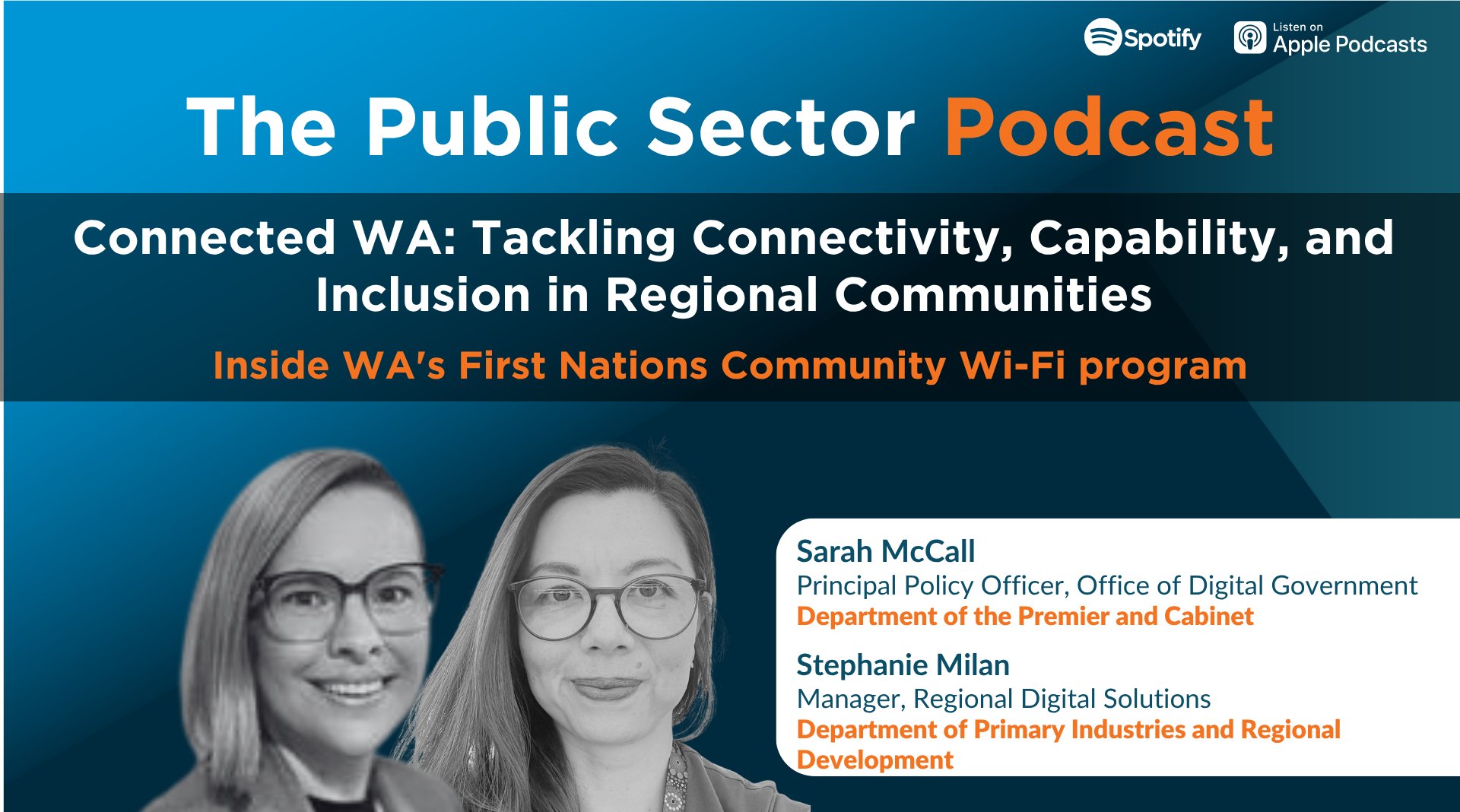
In this episode we are joined by Sarah McCall, Principal Policy Officer, Office of Digital Government, Department of the Premier and Cabinet and Stephanie Milan, Manager, Regional Digital Solutions, Department of Primary Industries and Regional Development explain how their two roles fit together - the Office of Digital Government holding the whole-of-government policy remit for statewide connectivity, and DPIRD delivering the infrastructure, industry partnerships and grants. Their shared point: WA can't be digital first if Western Australians can't connect.
Key Takeaways
- The market won't solve this alone. Building terrestrial networks in remote WA isn't commercially attractive. Competition thins out the further you travel - head into the Kimberley and you may have one provider. Mobile Black Spot rounds seven and eight were massively undersubscribed because industry simply didn't want to build.
- State government has invested heavily. Over $150 million since 2017 in federal co-investment programs, with a growing focus on resilience - because when mains power goes down, so do comms.
- Indoor Wi-Fi is the WA difference. Other national community Wi-Fi programs deliver outdoor coverage only. WA's First Nations Community Wi-Fi model funds free indoor access too, and the data shows a six to tenfold increase in usage. It also means a telehealth consult happens in the privacy of your own home, not standing beside a hotspot or in a public library.
- Demand is enormous. Bidyadanga in the Kimberley recorded roughly 30 terabytes of usage over a three-month period. Free access directly addresses the affordability barrier.
- The VoIP phone was an unexpected win. Each household gets an extension on a community number - like a hotel system. Prepaid plans lapse and mobile numbers change constantly, so a fixed line gives providers such as Horizon Power a reliable way to reach a specific household.
- Digital-first thinking can be metro-centric. A Service WA payment taking one minute instead of ten is a genuine win - unless you don't hold a birth certificate. A federal alternative ID proof of concept, using vouching into the MyGov ID system, is one attempt to close that gap.
- A device isn't inclusion. The National Device Bank Social Impact Report found donated devices only worked where they were fit for purpose. One recipient described a wiped laptop with no operating system as being about as useful as a metal frisbee.
- Wraparound support is what makes it stick. The WACOSS-led WA Digital Inclusion Project paired devices with in-community, one-on-one help - including Mowanjum, which received 40 devices alongside hands-on training. Community resource centres remain critical hubs, and success stories include people learning Canva to promote and sell their art.
- Technology change creates new gaps. The 3G shutdown showed how quickly shifts in technology can strand regional users. With 5G and low Earth orbit satellites now in play, advocacy for those left behind is ongoing.
- A gap just opened up. Regional Tech Hub - which helped people understand their connectivity options, price points and trade-offs - lost federal funding this year, and state government is reconsidering its role in filling that space.
Why You Should Listen
For anyone working in digital inclusion, regional service delivery, telecommunications policy, digital health or community programs - this is a grounded look at what genuine connectivity requires beyond infrastructure, and why the wraparound matters as much as the network.






Help your peers
Share what you've learned with fellow public servants