

Governments across APAC are deploying AI to improve citizen engagement and automate services, but fragmented initiatives create duplicated journeys, repeated identity checks, and unclear accountability. AI orchestration provides the control layer that aligns models, data, rules, and channels into a single end‑to‑end service experience, with governance built in.
Public sector leaders are under a familiar, difficult pressure: move faster on digital services without compromising trust. AI mandates are increasingly part of the answer. Agencies are deploying virtual assistants to improve citizen engagement, automating routine enquiries, and using analytics to support better decisions in areas like health, transport, revenue, and public administration.
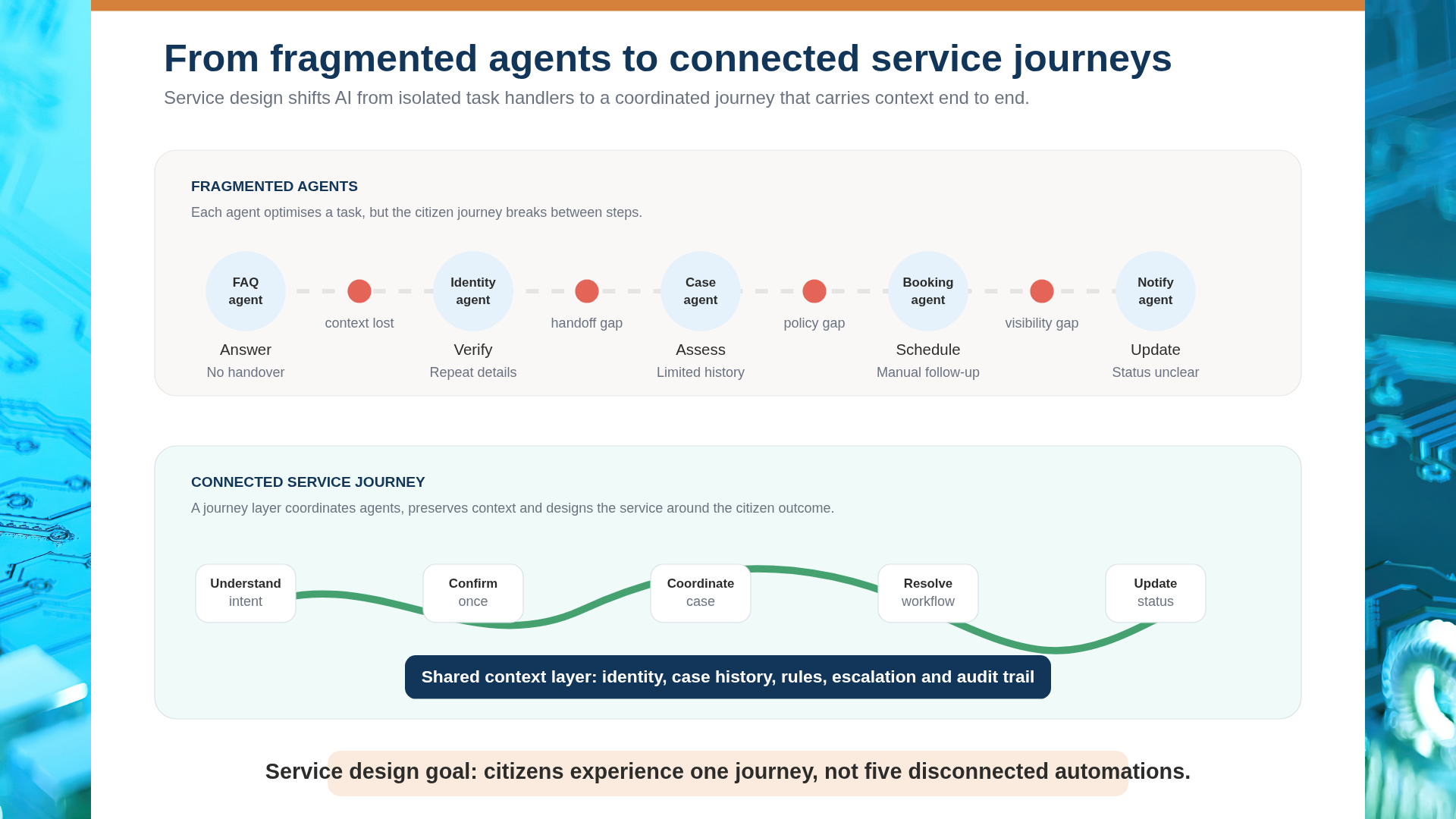
Yet a new constraint is emerging as adoption scales. Many ministries and agencies are implementing AI independently, on different platforms, with different data and governance models. The result is often fragmented experiences and fragmented accountability, and citizens notice it quickly. A resident might start a transaction online, follow up via phone, and then ask a question via messaging, only to find they must repeat details each time. A permit or benefits process that spans identity checks, eligibility rules, scheduling, payments, and notifications becomes a sequence of disconnected steps rather than a single service journey.
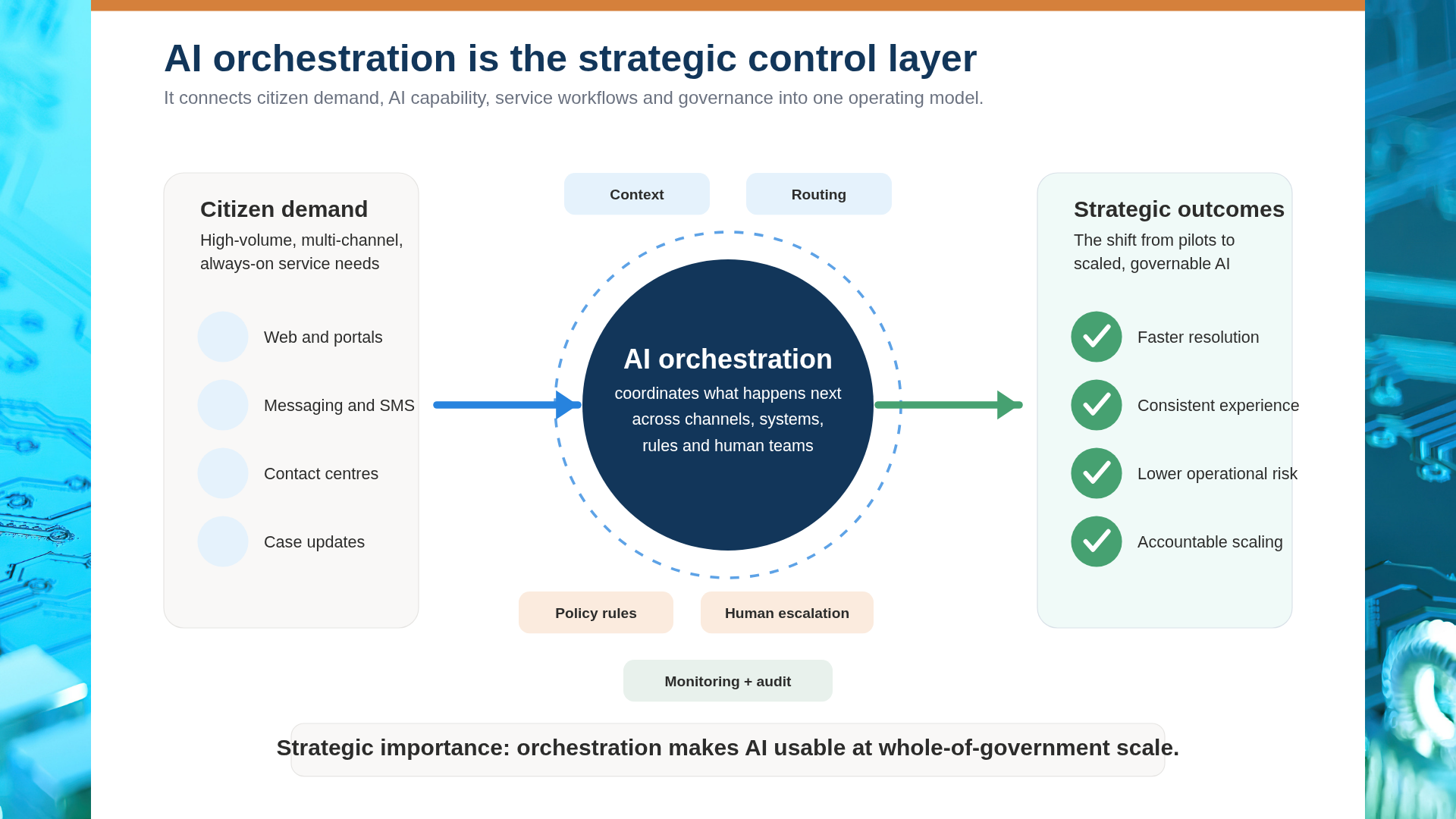
This is where AI orchestration becomes strategically important for digital government. Orchestration is the coordination layer that connects AI capabilities, data, business rules, and communication channels so interactions are managed as one continuous experience, rather than a set of isolated touchpoints. It determines what should happen next, which AI capability (or human team) should act, what context should be applied, and how outcomes are monitored and improved.
From agent proliferation to a joined-up service journey
Many government AI programs start with a sensible first step: an FAQ assistant that reduces call volumes and improves 24/7 access to information. These deployments can deliver quick wins in high-demand scenarios: emergency information, election enquiries, appointment bookings, renewal guidance, and status updates on common transactions. They also help relieve pressure on service teams that are dealing with increasing volumes and rising citizen expectations.
But as soon as use cases expand beyond one queue or one department, limitations show up. A single bot may handle “What do I need to renew my licence?” but struggle when the citizen’s need crosses multiple systems (identity, case history, payments, appointment availability, exceptions), or when the citizen changes channels. Without orchestration, agencies often end up building multiple AI “islands”: separate chatbots, workflow automations, and knowledge bases that don’t share context or coordinate escalation. The experience can feel inconsistent, repetitive, and (critically for government) hard to govern.
Orchestration shifts AI from point solutions to whole-of-journey service design. It enables governments to scale intelligence while protecting continuity, consistency, and oversight.
Why fragmentation becomes a service risk (not just an IT issue)
As AI spreads across the public sector, fragmentation creates three compounding risks:
1. Inconsistent citizen experiences
Citizens interact with “government” as a single institution, not a set of agencies. When service quality differs across channels and departments, trust erodes, even if each individual program is well-intentioned.
2. Disconnected context and data
AI is only as effective as the context it can access. If citizen history, eligibility, and prior interactions remain siloed, the AI experience becomes shallow and repetitive, forcing citizens to restate information and increasing the likelihood of errors.
3. Uncontrolled scaling of automation
As automation expands, governance becomes harder: who is accountable for decisions, how exceptions are handled, and how changes to policy or regulation propagate into service logic. Without clear control points, “more AI” can translate into more operational risk.
AI orchestration directly addresses these risks by bringing coordination and control into the centre of digital service delivery.
What orchestrated AI enables in government
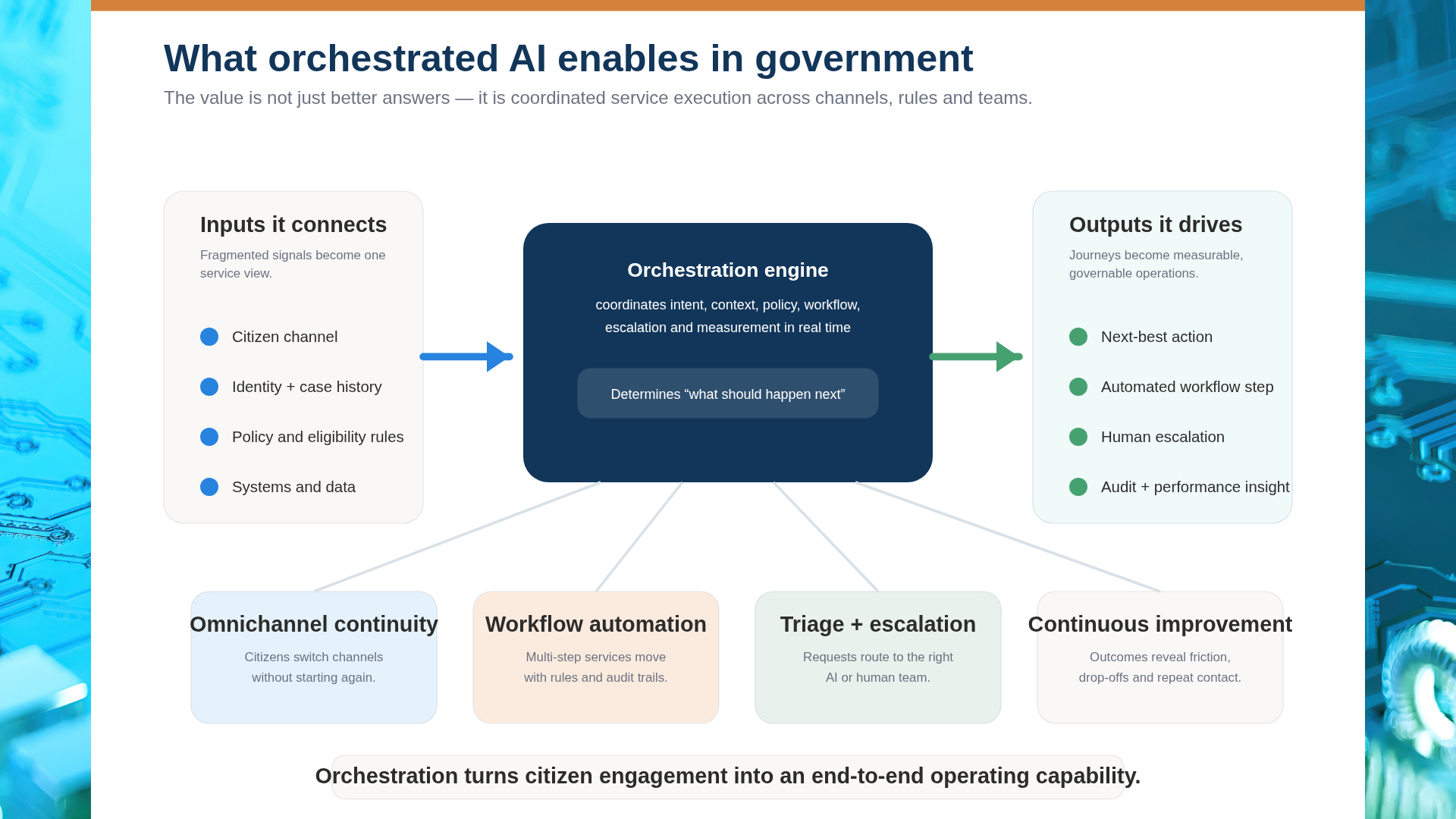
At its core, orchestration is about coordinating what happens next across channels, systems, and capabilities. In a government setting, that translates into practical improvements that executives care about:
- Seamless omnichannel journeys
Citizens move between web, SMS, messaging apps, email, and voice. Orchestration helps ensure a citizen can switch channels without losing context, reducing repeat handling and improving resolution speed.
- Smarter workflow automation (not just better answers)
Many government services are inherently multi-step: permits, registrations, benefit applications, inspections, renewals, case updates. Orchestration can automate parts of these workflows while enforcing business rules, capturing audit trails, and routing exceptions appropriately.
- Better triage, routing, and escalation
Instead of one generalist chatbot trying to do everything, orchestration can route an enquiry to a specialist capability (or a human team) based on intent, risk, and policy requirements, passing full context to avoid citizens starting over.
- Continuous monitoring and improvement
Orchestrated systems can measure outcomes (resolution rates, repeat contacts, time-to-complete, drop-offs) and use those signals to improve journeys over time. This supports a shift from “pilot delivery” to operational maturity.
The next wave: agentic AI and more autonomous service operations
Alongside orchestration, many government organisations are now exploring agentic AI, systems that can plan and execute multi-step tasks to achieve a goal, rather than simply responding to prompts. In a public sector context, agentic capabilities may assist with tasks like routing citizen requests, coordinating follow-ups, processing routine applications under defined rules, or proactively identifying missing information early in a workflow.
However, autonomy introduces complexity. Multiple agents operating across multiple services can quickly become difficult to manage unless there is a clear coordinating layer to maintain context, govern actions, and ensure accountability. This is why orchestration and agentic AI are complementary: agents provide task capability; orchestration ensures those capabilities work together safely and coherently.
Governance and responsible AI: designed in, not bolted on
Government AI must meet a higher bar than most commercial deployments. Decisions need to be explainable; outcomes must be auditable; and deployment must align with policy intent, privacy obligations, and community expectations.
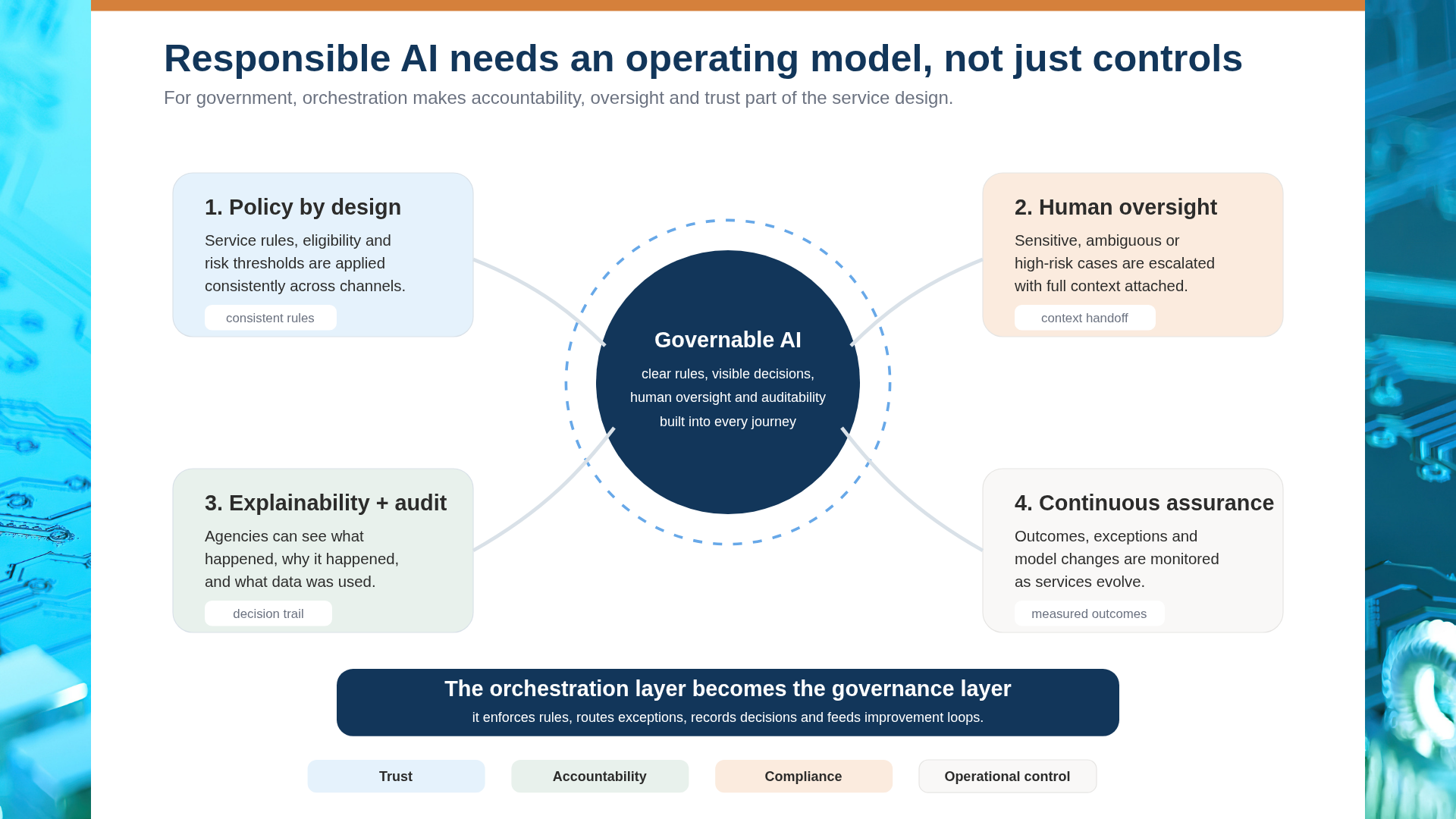
Orchestration supports responsible implementation by centralising the mechanisms that matter:
- consistent policy enforcement across channels and departments
- human-in-the-loop escalation for sensitive, ambiguous, or higher-risk cases
- visibility into decision flows (what happened, why, and based on what data)
- controlled change management as policies, service rules, and models evolve
For executives, this is the difference between isolated automation and scaled, governable capability.
Where Infobip fits
As governments modernise citizen engagement, communication is increasingly conversational and omnichannel, spanning web chat, messaging, SMS, voice, email, and contact centre pathways. Platforms that support orchestration can help agencies connect these channels with service workflows and the AI capabilities operating behind them, accelerating delivery while reducing integration risk and avoiding costly errors that come from inconsistent, duplicated logic.
Infobip’s AgentOS is positioned around this orchestration challenge: helping organisations connect AI agents, customer data, workflows, analytics, and communication channels into one coordinated engagement layer. Rather than treating chatbots, contact centre interactions, messaging, and workflow automation as separate initiatives, AgentOS is designed to support connected journeys across channels including SMS, email, voice, live chat, WhatsApp, Messenger, and other messaging apps.
For government, the relevance is the ability to create AI agents once and deploy them across multiple channels, while maintaining context through unified customer profiles, conversation history, sentiment, behavioural signals, and analytics. This supports more consistent citizen experiences, better routing and escalation, and clearer visibility into where journeys succeed or break down.
The platform also reflects the governance requirements discussed above: AI-to-human handover with full context, guardrails and audit trails, integration with existing systems and data sources, and enterprise security and compliance controls including SOC2, ISO27001, GDPR alignment, and AES-256 encryption. For agencies moving beyond pilots, that combination of orchestration, omnichannel delivery, data unification, and control is where Infobip’s approach fits.
The bigger point is this: as APAC governments expand AI across services, the challenge is shifting from “can we deploy AI?” to “can we coordinate AI across government responsibly?” Orchestrated AI provides a practical blueprint for that next phase, connecting the parts, reducing friction, and delivering the consistent service experience citizens now expect.
For public sector leaders looking to scale AI beyond pilots, the next step is to assess where orchestration can unify fragmented initiatives, starting with a high-volume citizen journey and designing for continuity, control, and measurable outcomes end to end.



Published by
About our partner
Infobip
About Infobip:Infobip is a global cloud communications platform that enables businesses to build connected experiences across all stages of the customer journey, with AI as the driving force of innovation. Through a single, natively built platform, Infobip delivers omnichannel engagement, identity, user authentication and contact centre solutions that help businesses and partners overcome the complexity of consumer communications while driving growth and increasing customer loyalty. Infobip is focused on enabling and accelerating AI adoption as it continues its transformation into an AI-first company. Infobip’s technology has the capacity to reach over seven billion mobile devices in 6 continents connected to over 10k+ connections of which 800+ are direct operator connections. The company was established in 2006 and is led by its co-founders, CEO Silvio Kutić and Izabel JelenićRecent award wins include:Infobip recognized as a growth and innovation leader in Frost Radar™: Communications Platform as a Service (CPaaS) by Frost & Sullivan (Oct 2025)Infobip ranked as the number one Established Leader in the Juniper Research Mobile Messaging Fraud Prevention Market report (Sept 2025)Infobip named a Leader in the Gartner® Magic Quadrant™ for Communications Platform as a Service (CPaaS) for the third consecutive year. In 2025, positioned furthest in Completeness of Vision (July 2025)Infobip named among Top 75 in Fortune’s Europe’s Most Innovative Companies 2025, placing it in the top 25% of all listed organizations (June 2025)Infobip ranked as a Leader in the Omdia CPaaS Universe Report for the third time (April 2025)Infobip ranked an Established Leader in the Juniper Research Conversational AI Leaderboard (Feb 2025)Infobip named a CPaaS Leader for the third time in the IDC MarketScape (Feb 2025)
Learn more





Help your peers
Share what you've learned with fellow public servants