

Welcome and State Scene Setter: Government Spending, Direction and Priorities
Judy Hurditch — Intermedium
- WA agencies are actively testing AI, but most remain at pilot or early-production stage. Leaders need a clear view of organisational readiness before expanding adoption.
- Risk appetite, use-case registers and responsible deployment are becoming executive governance questions rather than technical-team concerns.
- Cross-agency learning and candid discussion of what has and has not worked will be important as agencies move beyond isolated experiments.
Ministerial Address
Yaz Mubarakai — Parliamentary Secretary, speaking in place of Hon Stephen Dawson MLC
- Government innovation should be judged by whether it makes difficult interactions easier and improves outcomes for Western Australians, not by the novelty of the technology.
- The WA Digital Strategy links ServiceWA, digital credentials, responsible information sharing, AI investment and cybersecurity into a common service agenda.
- Digital delivery must expand access without excluding people who need local, telephone or face-to-face assistance.
State Briefing: Digital Strategy 2026–2030 — The Next Era of Opportunity and Priorities for WA
Jonas Petersen — Office of Digital Government, Department of the Premier and Cabinet
- WA is shifting from establishing digital foundations to adoption at scale, with central platforms and shared capabilities intended to reduce fragmented agency experiences.
- State Digital Assets should be built for use across agencies, supported by clear operating models, central oversight and accountable service ownership.
- The 2030 roadmap depends on better information about service volumes, delivery channels, identity checks, ICT costs and measurable benefits.
Powering WA’s Digital Productivity Revolution
Jonas Petersen — Office of Digital Government; Ryan Sengara — Department of Treasury and Finance; Phil Greenhalgh — Department of Transport and Major Infrastructure; facilitated by Judy Hurditch — Intermedium
- Adoption at scale requires more than technology: governance, funding, incentives, delivery capability and cross-agency ownership must support the same direction.
- Staged funding and regular assurance can reduce uncertainty while allowing large programs to progress through evidence-based decision points.
- Benefits should include time, productivity, safety, resilience, accessibility and public trust, not only direct financial savings.
Innovation Spotlight: AI Innovation and Successful Use-Cases in Government
Ashleigh Stokeley — Department of the Premier and Cabinet; Alex Jenkins — WA Data Science Innovation Hub and AI Advisory Board
- Agencies should define the service or operational problem before choosing an AI tool, then test whether automation is appropriate for the consequence and context.
- High-volume, repetitive and well-understood workflows are strong early candidates, while decisions affecting rights, health or wellbeing require greater assurance.
- Human users remain accountable for reviewing AI output, applying professional context and escalating higher-risk applications for independent advice.
A Blueprint for Public Sector AI Adoption
Joel Macfarlane — Datacom
- Moving beyond copilots and grassroots pilots requires an AI charter, governance, role-specific learning, safe experimentation and executive sponsorship.
- Agencies need an inventory of agents, permissions, tools, activity and cost so agent-enabled work can be monitored and controlled.
- AI can change citizen services, software delivery and back-office work, but identity, consent, trusted data and auditable human approvals remain essential.
State Digital Assets: Unpacking Emerging Priorities and Next Steps for Advancement
Alberto Degli Esposti — Office of Digital Government, Department of the Premier and Cabinet
- Common platforms such as WA.gov.au, ServiceWA and the Identity Gateway can reduce duplicated procurement and shorten agency delivery time.
- Central capability does not remove agency accountability: the lead agency still owns the service, business rules and escalated support.
- Reuse must be paired with Digital Assist, telephone support and inclusive identity pathways so central platforms work for people across WA.
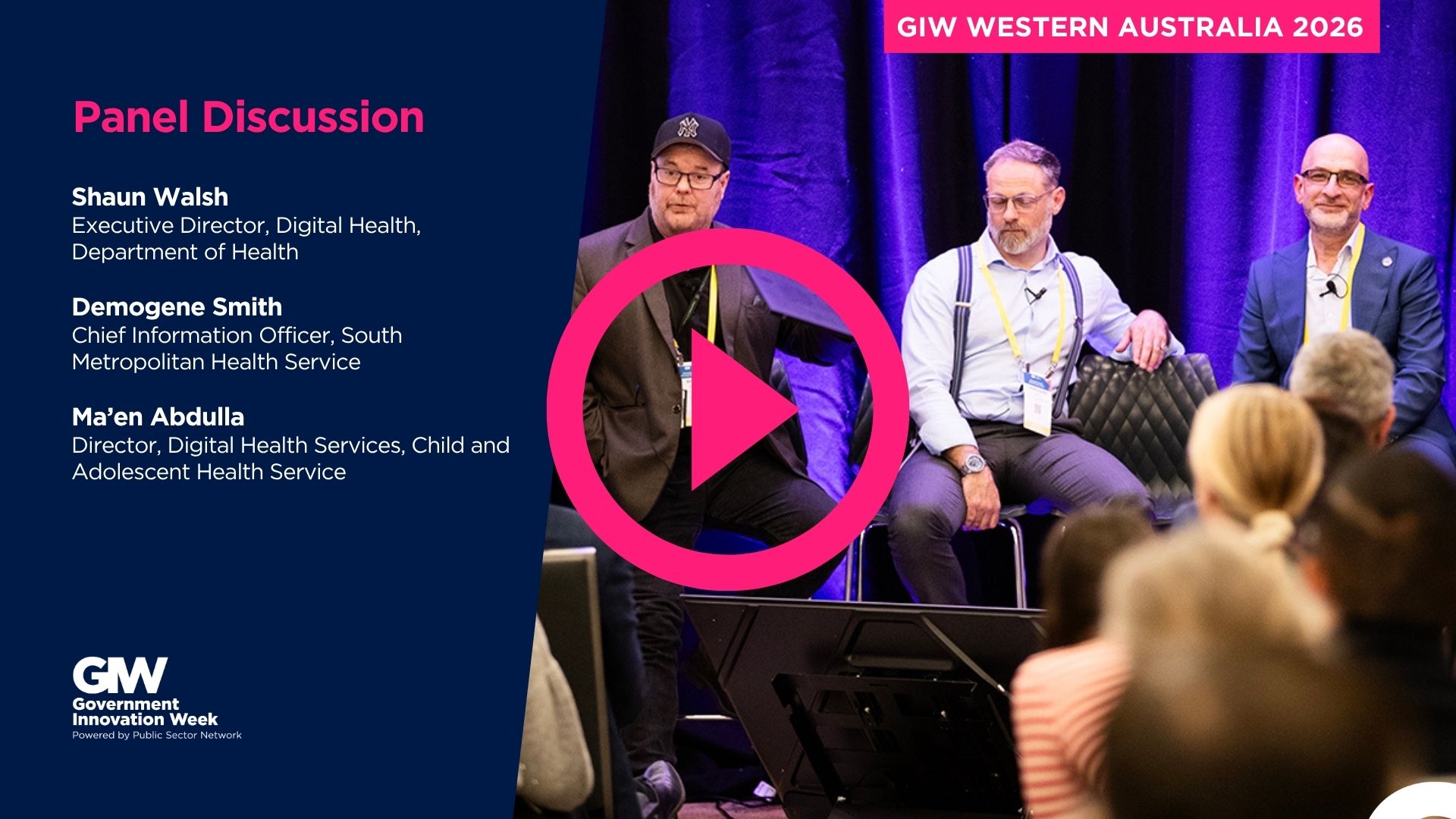
From Vision to Impact: Advancing Digital Health Across WA Health Systems
Shaun Walsh — Department of Health; Demogene Smith — South Metropolitan Health Service; Ma'en Abdulla — Child and Adolescent Health Service
- Scaling virtual care requires operating-model change, reliable connectivity and services designed around people rather than hospital buildings.
- Shared records, interoperability and near-real-time data can improve patient flow and access, provided consent, clinical governance and data quality are addressed.
- AI and ambient clinical tools should reduce administrative work while preserving clinical judgement, human oversight and careful change management.
Connected WA: Tackling Connectivity, Capability and Inclusion in Regional Communities
Stephanie Milan — Department of Primary Industries and Regional Development; Sarah McCall — Office of Digital Government, Department of the Premier and Cabinet
- Digital inclusion depends on access, affordability and ability; connectivity alone does not solve barriers involving devices, identity documents or confidence.
- Free indoor community Wi-Fi allows remote residents to use telehealth and sensitive services privately, while stable VoIP contact supports service continuity.
- Infrastructure programs work best when paired with suitable devices, local mentors and trusted community organisations that provide practical support.
The Next Era of Digital Capability in WA
Owen Johnstone — Department of Transport and Major Infrastructure; Alysha Clark — Office of Digital Government, Department of the Premier and Cabinet
- Digital-first should not mean digital-only: app, web, paper, phone and face-to-face pathways remain necessary for different needs and preferences.
- User research, personas, prototyping and direct assistance reveal service problems that internal assumptions and the loudest feedback can miss.
- Trust develops through successful experience, reliable support and continuous improvement, not only through security controls and policy statements.
Technology, Data and AI Integration Track Welcome
Brandon Voight — OpenText and Future Government Institute
- Government 3.0 shifts from paper-based and departmental processes toward connected services organised around people's needs.
- The next stage of AI adoption is repeatable production value, not a larger collection of disconnected pilots and demonstrations.
- Trusted information management and clear human oversight are prerequisites for hyperautomation, personalised communication and agent-based services.
Integrating Responsible and Effective Data Sharing and AI Governance Within WA Public Sector
Keith Moss — Office of Digital Government, Department of the Premier and Cabinet
- Governance enables confident experimentation by setting proportionate safeguards, executive accountability and independent review for higher-risk uses.
- Successful projects start with a measurable problem, reliable data, organisation-wide support and a clear method for assessing community value.
- The AI Centre of Excellence combines funding, technical specialists, university and industry collaboration, and a simpler buying pathway to support coordinated delivery.
Battle-tested Building Blocks: How AI Powering Low Code Delivers Safer, Governable App Development
Martin Cooperwaite — Kiandra IT
- Unconstrained AI coding can produce fast prototypes but also large review burdens, security uncertainty and fatigue before an application reaches production.
- AI-generated applications built from tested low-code components can constrain development to known building blocks while retaining platform controls and audit evidence.
- Agencies should test representative complexity through a limited proof of concept, then validate security, accessibility, maintainability and benefits before scaling.
Privacy, Data and AI Governance, Transparency and Trust
Damian Shepherd — State Records Office; Annelies Moens — Office of the Information Commissioner; Sonya Sherman — Office of Digital Government; Anu Sutharshan — Department of Transport and Major Infrastructure; facilitated by Brandon Voight — OpenText
- Agencies need to know what information they hold, who owns it, where it came from, how it is classified and when it should be disposed of.
- Privacy and responsible information sharing are complementary when purpose, access, provenance, risk and technical safeguards are built into workflows.
- Automated decisions need transparency and traceability; prompts, assessments and supporting information may form part of the official record and audit trail.
From Infrastructure to Intelligence: Measuring the Outcomes That Matter
Kevin Harper — Visa Consulting & Analytics
- Place-based decisions need shared context across movement, spending, transport, planning, safety, environment and community conditions rather than isolated metrics.
- AI can shorten the path from a policy question to evidence, but it should test explanations and scenarios rather than make the policy decision.
- Data clean rooms and aggregated outputs can support cross-organisation insight while preserving control of underlying information and limiting exposure of individual behaviour.
DGov’s Strategic Technology Advisers: Lessons Learnt in Tech, Data and AI Integration Across WA Agencies
Michelle Simpson — Office of Digital Government, Department of the Premier and Cabinet; interviewed by Brandon Voight — OpenText
- Successful ICT programs begin with active executive sponsorship, an empowered senior responsible officer and experienced delivery, architecture and change capability.
- Agencies should connect business and ICT strategies, establish a baseline of the current environment, and fund discovery and delivery in manageable stages.
- AI does not remove project fundamentals: agencies still need clear outcomes, governed data, sound integration, trained users, human review and firm prioritisation.
Executive Panel: Creating a Modern, Relevant and Trustworthy WA Public Service
Sean Halligan — Department of Justice; Rebecca Ostergaard — CSIRO; Damian Shepherd — State Records Office; Shaun Walsh — Department of Health
- Workforce planning should distinguish work that must remain human-led from work that technology can support, with accountability staying with public servants.
- AI capability is not limited to technical skills; leaders and teams need critical thinking, domain knowledge, judgement and confidence to question outputs.
- Adoption will depend on culture, practical learning and workforce redesign that preserves professional expertise while reducing low-value administrative work.




Help your peers
Share what you've learned with fellow public servants