
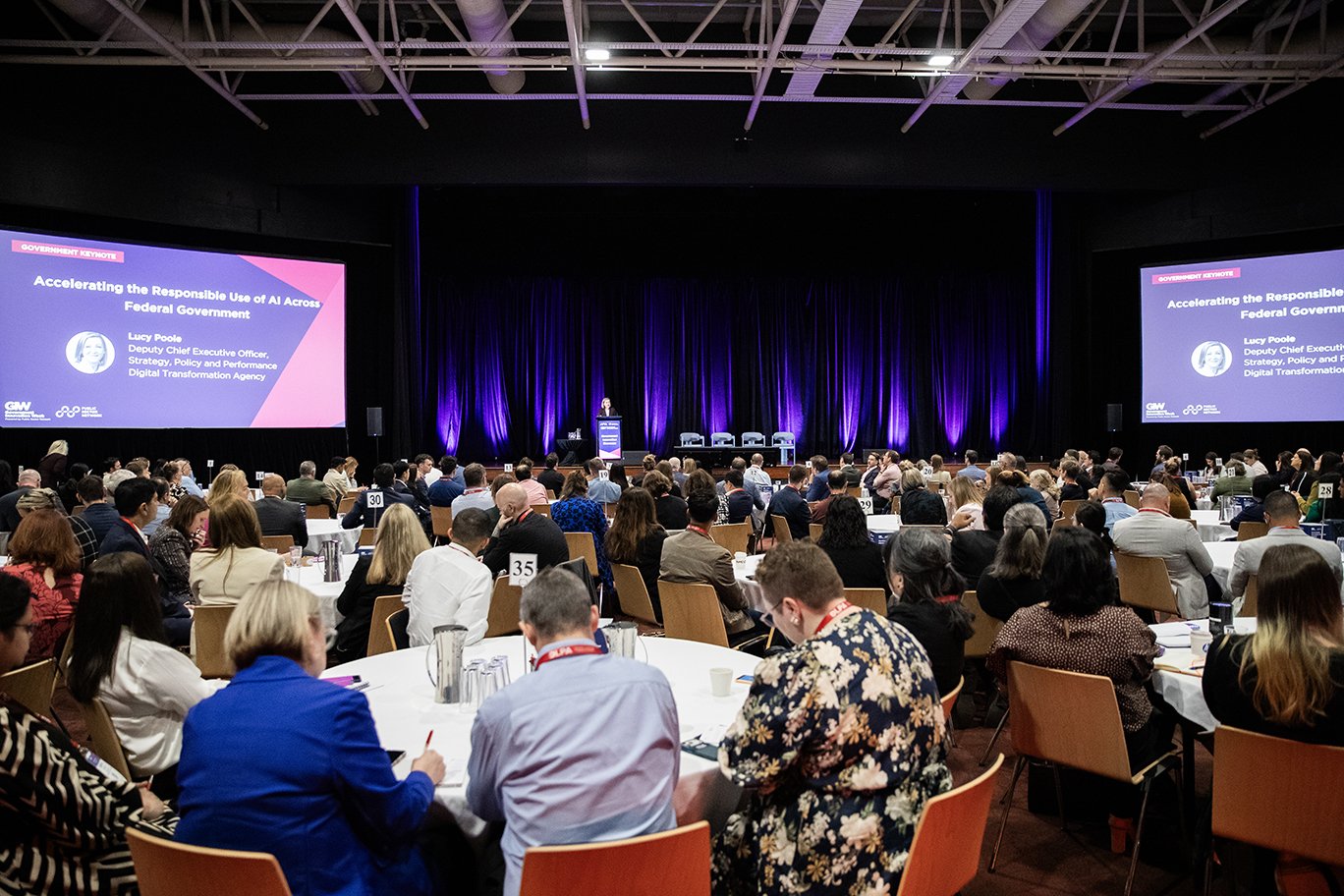
Morning plenary
Executive Panel: Unpacking Successful AI Use Cases and Innovation Wins Across the Australian Government
Lucy Poole — Digital Transformation Agency
Paul Robards — Department of Defence
Cindy Dickson — Salesforce
Daniel Livesey — Department of Finance
- Start with clear success measures and guardrails when introducing AI into workflows. Connect use cases across a staff or citizen journey, and address data silos before attempting to scale.
- AI can support staff wellbeing as well as productivity. The panel discussed using it to identify and obscure disturbing images, reducing the material staff need to view.
- Large volumes of information can make decision-making difficult. Find ways to help staff locate and interpret relevant data, while recognising that its sensitivity can vary by use.
Sustainable for the Public Sector
Michael Boots — Everpure
- Track how model choice, input size and repeated use affect AI costs. Set practical controls before scaling access.
- Consider deployment options, including open-weight models, against security, operating costs and capability needs rather than assuming one model fits every task.
- Prepare and govern the data that AI tools retrieve. Test whether information is current and appropriate for the intended use.
Rancher Government Carbide: Advancing FVEY Coordination Through Secure Infrastructure
Dylan Miller — Rancher Government Solutions
- Choose where applications and data run according to mission, security and operational needs, rather than assuming every workload belongs in the cloud.
- Apply zero-trust principles and software supply-chain checks to infrastructure used across agencies and partner countries.
- Plan for applications to operate across cloud and constrained environments. Test whether the chosen platform supports shared requirements and local controls.
Digital Services, CX and AI Innovation
The Future Citizen: Building Government Services with the Next Decade in Mind
Jordan Hatch — Services Australia
- Start with services that are accessible and easy to use, and design around the circumstances people face rather than agency boundaries.
- Strengthen the foundations as services expand: account recovery, multi-factor authentication and digital identity all affect confidence in online services.
- Work across agencies and jurisdictions on customer journeys. Shared platforms such as myGov can reduce the need for people to navigate each agency separately.
The Predictability Problem: Why Government AI Stalls at the Pilot
Robert Bollard PSM — Pega
- Distinguish probabilistic AI output from the rules and controls needed for predictable government processes.
- Place AI within a defined workflow so people can understand where it supports a decision and where other controls apply.
- Test the full path from design to operation, not just a demonstration. The keynote offered a vendor perspective on using workflow platforms to support that path.
Services That Adapt to You: Personalised Government in the Digital Age
Niki Strachan — Digital Transformation Agency
Claire Miller — Australian Taxation Office
- Define the shared outcome for citizens before choosing a product or starting a build. Test whether each investment moves that outcome.
- Connected services require agencies to work with existing digital infrastructure and each other, rather than designing every journey in isolation.
- Review legacy costs, operating models and options as work progresses. Leaders should be prepared to change or stop an approach that is not delivering value.
Beyond Digital: How AI Is Shaping Government Service Delivery
Adam Shain — Department of Employment and Workplace Relations
- Start with user needs and examine the business process before applying AI. Automating a poor process can preserve its problems.
- Use small, time-limited tests to identify promising ideas, then measure their value before deciding whether to scale.
- Keep people accountable for decisions and put data and access controls in place as AI moves from internal productivity towards service delivery.
Technology, Data and AI Integration
AI Governance in Practice: Balancing Innovation, Risk and Public Trust
Alana Lundy — Department of Social Services
- Citizen trust depends on how agencies protect information and apply AI in practice, not on principles alone.
- Match controls and permitted uses to the sensitivity of the work. Some cohorts or activities may need to remain outside AI use.
- Build staff curiosity and adaptable skills rather than training people on one tool only. Share lessons from failures as well as successes.
A Blueprint for Public Sector AI Adoption
Paul Hyland — Datacom
- Connect AI plans to service outcomes, workforce changes and public expectations about responsible data use.
- Assess people, process and technology together. Prioritise use cases before setting a roadmap and operating model.
- Use automation and document or data understanding where they reduce routine workload, while planning how staff will use the capacity released.
Overcoming Systemic Issues and Barriers to AI Adoption in Federal Government
Daniel Livesey — Department of Finance
Ramsey Beydoun — Digital Transformation Agency
Ian Koeglenberg — Deloitte Australia
- Moving beyond pilots requires attention to funding, procurement, assurance and operating models as well as technology.
- Assess AI risks against their likelihood and impact. Invest in data foundations while pursuing proportionate, lower-risk use cases.
- Make capability building specific to roles and share work across agencies. Business analysts, operational teams and technical staff all need a place in use-case design.
From AI Ambition to Impact
Greg Frith — Deloitte Australia
- Move beyond isolated proofs of concept by selecting end-to-end processes and assigning executive ownership for the change.
- Measure returns at decision gates and use the evidence to guide further investment. Consider changes to the technology, business and cost models together.
- Co-design with users and build staff judgement about when to use AI. Tool training alone does not address change readiness or the risk of accepting outputs without challenge.
Business Strategy and Technology Strategy
Kristin Auld — Australian Federal Police
Belinda Duffy — Department of Finance
- Observe how staff perform their work before selecting a solution. A new interface or system is not an improvement if it disrupts the job it supports.
- Build trust between business and technology teams, and create controlled spaces where staff can test ideas with a path to production.
- Connect business and technology strategies through clear outcomes. Make AI use visible and retain human responsibility for decisions and accuracy.
AI Enhanced Productivity
Reimagining Government Operations
Nicky Bell— Australian Bureau of Statistics
Belinda Duffy — Department of Finance
- Start with public value and distinguish what people do, what AI does, and what they do together.
- Retain human judgement for decisions with accountability or context that a tool cannot reliably assess. Use any time released to improve service and human interaction.
- Measure whether a change achieves the intended outcome, not just whether it is faster. Build staff confidence through open discussion and practical support.
Three Tasks to Automate. Three to Leave Alone.
Karlie Cremin — DLPA/Crestcom ANZ
- Map the time and friction in current processes before choosing tasks to automate. Include checking and correction time in the business case.
- Do not assume time saved becomes spare capacity. Teams experiencing sustained workload pressure may first need that capacity to return to a manageable baseline.
- Design a way to surface exceptions rather than forcing every case into a predefined category. Preserve human attention where context and judgement matter.
The Future of Work: Integrating Tech and People for Next-Generation Public Service Delivery
Sarah Polhill — Australian Competition and Consumer Commission
Jade Carson — National Gallery of Australia
Melanie Morrissey — RPS
- Align AI tools with the organisation’s purpose and bring business, technology and staff representatives into adoption decisions.
- Make space for staff who are cautious as well as enthusiastic. Training and practical examples help people build confidence at different speeds.
- Set boundaries for sensitive or creative work. The panel discussed copyright, First Nations data and the importance of preserving human creativity and judgement.
AI at Work: Real World Productivity Gains in Federal Government Operations
Thomas Ryan — Australian Electoral Commission
- Ask staff to identify the business problem before choosing an AI tool. Question whether an existing process is needed before automating it.
- Build staff confidence alongside clear guardrails and senior support, especially where public trust and electoral responsibilities are involved.
- Measure adoption and benefits through feedback and working groups. Consider how capacity can support judgement, accessibility and better service.
Afternoon plenary
CAIO Panel: The Strategy, What Chief AI Officers Are Doing to Drive Adoption and Impact
Dimitar Dimitrovski — Fair Work Ombudsman
Simon Cooper — Department of Home Affairs
Scott McAllister — Procsi
Monita Lal — Department of Finance
- Start with a small, useful problem and demonstrate the result to business, legal and executive colleagues. Use feedback to refine both the tool and its controls.
- Give staff a safe way to propose and test ideas. Explain how AI will support their work and make decision accountability clear.
- Connect AI adoption to data quality, legal obligations and the organisation’s risk settings. Measure the effect on work, not just the number of tools deployed.
Executive Panel: Building Capability for a Changing Workforce, Skills, AI and the Future of Work
Simon Booth - Jobs and Skills Australia
Shannan Quain - Australian Digital Health Agency
Catherine McLachlan- Department of Finance
Sonia Eland - HCL Tech
- Assess how AI may change individual tasks as well as whole occupations. The research discussed focused on augmentation rather than agentic AI.
- Map the skills needed for future delivery against current capability, then plan development and recruitment around those gaps.
- Create time for learning while staff continue to deliver services. Recognise practical peer learning as well as formal training and qualifications.





Help your peers
Share what you've learned with fellow public servants