
AI offers public sector organisations the opportunity to spend less time on routine tasks and more time on work that requires human judgement. But in a prosecution environment, that opportunity comes with important questions about privacy, fairness and accountability.
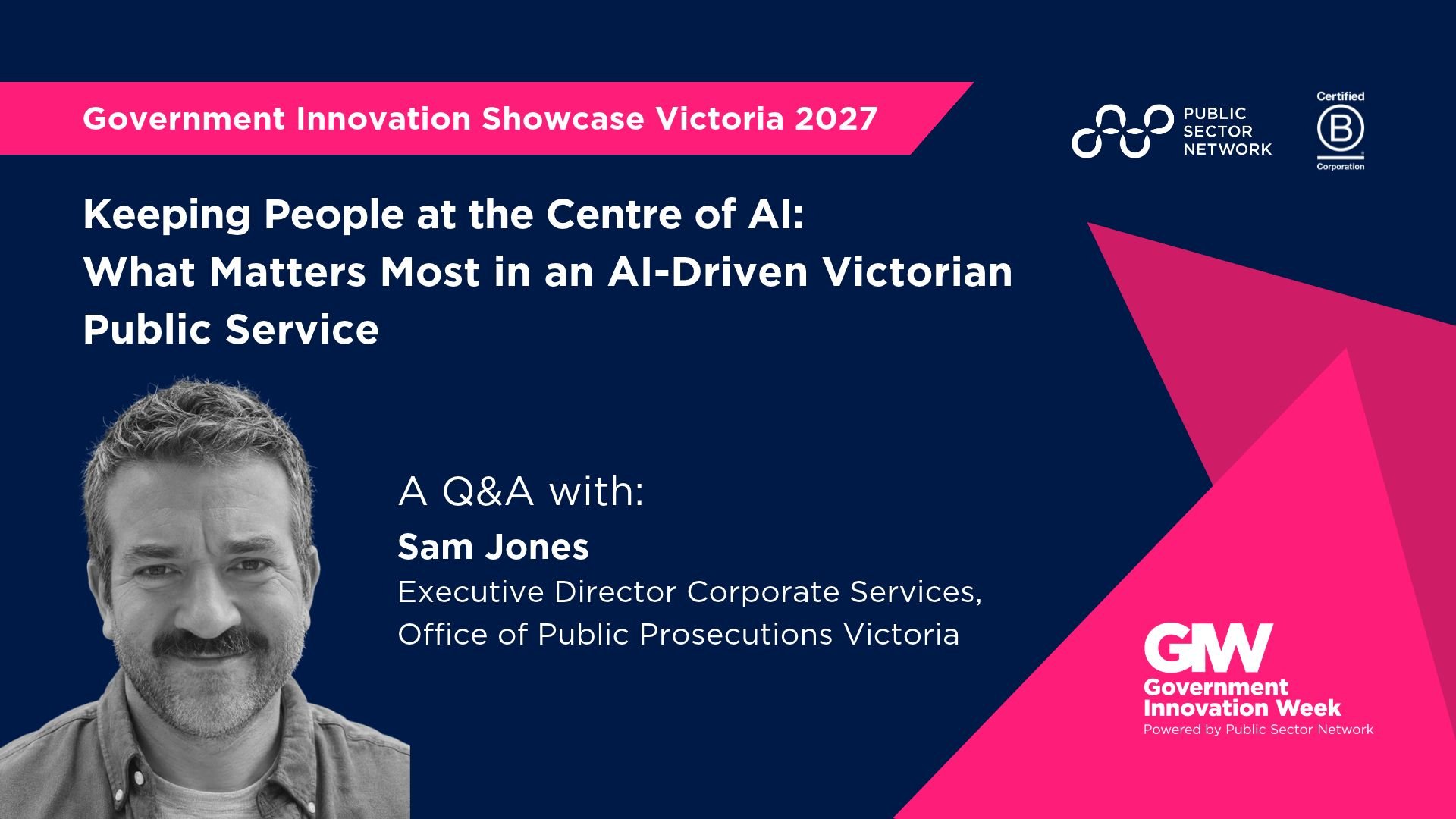
For Sam Jones, Executive Director Corporate Services at the Office of Public Prosecutions Victoria, responsible innovation starts with a real problem, the people who do the work and a clear understanding of the risks.
Ahead of his participation in The Human Advantage panel at Government Innovation Showcase Victoria on 16 March 2027, we spoke with Sam about practical uses for AI, the responsibilities that must remain with people and the support teams need to challenge the technology’s outputs.
Explore the event: https://publicsectornetwork.com/events/government-innovation-week-victoria-2027-melbourne-2027/government-innovation-showcase-victoria-2027-melbourne-2027/overview/
Complimentary registration for government: https://psnevents.eventsair.com/government-innovation-showcase-victoria-2027/government-sso/Site/Register
From a corporate services perspective, where could AI free up time for more valuable work in a prosecution environment?
Sam Jones: There is significant potential in routine, high-volume work that currently takes people away from analysis, professional judgement and supporting others.
In corporate services, that could include producing first drafts that then need to be checked, summarising lengthy material, comparing documents, finding information—including fuller histories and sequences—preparing or analysing routine reports, validating and cleaning up data, and helping staff navigate policies and processes. In a way, it is taking the robot out of the human!
The objective should not simply be to do the same work faster. It should be to reduce administrative effort so our people can spend more time on judgement, complex problem-solving and delivering better, more tailored services.
We have seen through our own pilots that AI can significantly reduce the time taken on some tasks, but also where it can miss context or produce something that looks convincing but is wrong. That is why testing it against real work is so important.
Which decisions or responsibilities should remain firmly with people, and why?
Sam: Accountability must remain with people.
AI can assist a person to find, organise, analyse or challenge information, but it should not become the decision-maker. Any Victorian Public Service employee, regardless of role, function or grade, must understand the material, test the output and be able to explain and defend the decision. AI can help with these things too, but accountability cannot be outsourced.
There is an important distinction between using AI to support judgement and allowing AI to replace judgement. The first can improve the quality and timeliness of work. The second risks weakening accountability, professional obligations and public confidence.
How would you assess privacy, confidentiality and fairness before introducing an AI tool?
Sam: I would treat them as design and approval requirements from the outset, not matters to tidy up after the tool has been selected.
That starts with understanding exactly what information the tool will receive, where it is processed and stored, how long it is retained, who can access it, whether it is used to train models and how the information is deleted or returned when the service ends.
For my role in a prosecution agency, this needs to account for sensitive personal and health information, criminal histories, evidence, victim and witness details, protected identities and material subject to court orders or other restrictions.
A privacy impact assessment, security assessment and legal review should be supported by scenario testing against realistic things that can and do go wrong. I would also want to understand the contractual protections, audit logs, incident response arrangements, access controls, data location and retention periods, and whether we can suspend or switch off the service quickly if a significant risk emerges.
Fairness also requires us to ask who could be disadvantaged by the tool, whether its outputs may reflect bias, whether people can challenge an AI-assisted outcome, and whether the process remains transparent and explainable. The higher the potential impact on a person, the stronger the assurance and human oversight need to be.
What support do non-technical teams need to use AI confidently and challenge its outputs?
Sam: People need more than access to a tool and a one-off training session.
They need clear guidance about which tools are approved, what information can be used, what must never be entered, when AI use is appropriate and who remains accountable for the result. They also need practical examples based on their actual work, including examples where AI gets things wrong. People need not only awareness but permission too. Governance frameworks, done right, enable this.
Good AI capability is partly about learning how to use the technology, but it is equally about learning how to challenge it. Staff should be comfortable asking: Where did this come from? Is the source reliable? What has been missed? Is this consistent with the evidence? Could the answer be biased or fabricated? Would I be prepared to put my name to it?
Leaders also need to create an environment where people can raise concerns, report mistakes and discuss unsuccessful experiments. That is how an organisation learns where AI is useful, where it is not and what controls are genuinely needed.
How should leaders balance the drive for efficiency with the need for careful judgement in a prosecution environment?
Sam: Efficiency and careful judgement should not be treated as competing objectives. Used properly, AI can give people more time for careful judgement by reducing the administrative burden around it.
The balance comes from being clear about the purpose and risk of each use case. A tool helping to summarise an internal administrative document is very different from a tool assisting with evidence, a court document or informing a decision that affects an individual. The controls should reflect that difference.
Leaders should start with defined problems, test the technology in real work, establish clear accountability and measure more than time saved. We should also ask whether accuracy improved, whether risk increased, whether staff found the tool useful and whether the outcome was better for the people who rely on the service.
The right question is not simply, “Can AI do this?” It is, “Should we use AI for this purpose, under what conditions, and who is accountable for checking the result?”
What is one idea or action you hope attendees take back to their organisations after Government Innovation Showcase Victoria?
Sam: Choose one genuine business problem, test AI against it with the people who actually do the work, and build the governance around the real use case.
Do not begin with a broad ambition to “adopt AI” or assume that buying a product produces transformation. Start with a task that consumes time or creates frustration, establish what a good outcome looks like, identify the risks and then run a controlled pilot.
Most importantly, involve your people early. They will usually know where the real inefficiencies are, where professional judgement matters and whether the technology is genuinely helping. Responsible innovation works best when governance, technology and workforce experience develop together.
Continue the conversation at Government Innovation Showcase Victoria
Sam’s message is that AI should give people more room to apply their expertise—not replace their judgement. Start with a practical problem, involve the people doing the work and build proportionate safeguards from the outset.
Hear more from Sam during The Human Advantage panel at Government Innovation Showcase Victoria on 16 March 2027, part of Government Innovation Week Victoria.
Explore the programme and join the conversation: Government Innovation Showcase Victoria 2027.




Help your peers
Share what you've learned with fellow public servants