

Interestingly, Dark Triad people (Narcissists, Psychopaths, Machiavellians) can appear to have very high Emotional Intelligence (EQ)… would you believe you’re just as likely to get your average psychopath, narcissist or Machiavellian to stop and help as the ‘average’ person – more so if it would be beneficial to their image!
The book, ‘The Upside of your Dark Side’ is an interesting read/listen if you want to explore more.
However, while Dark Triad people can appear to have a very high Emotional Intelligence, they generally lack key components of true Emotional Intelligence like genuine empathy and remorse.
With that in mind, do you think AI is a psychopath, Machiavellian, or narcissist? All of the above? Personally I think the answer tends towards yes, potentially all of the above! Does that stop me using AI? No. But it certainly makes me think…!
Dark Triad people do often understand what others think or feel on an intellectual level and can often expertly read and decode other people's language, facial expressions or social cues.
They then use this "mind-reading" skill to help them appear charming and put on a great show of surface charm early on to win people over (does that sound like an AI you know…🤔).
The problem of course is Dark Triad people unfortunately use that positioning in a destructively manipulative way to trick, control, or use other people…🤔The Entity? Skynet?
Because Dark Triad people have that often very deep intellectual understanding of Emotional Intelligence, they often have a very inflated opinion of themselves that’s hard to hide (ChatGPT, you reading this…?).
Which is just one of the reasons I think self-rating Emotional Intelligence is, overall, a waste of time and money. Not just because of Dark Triad people though.
Self-rating Emotional Intelligence can be useful from the point that it gets people thinking about Emotional Intelligence in general, makes people aware of the various Emotional Intelligence competencies, and gives people a starting point for self-reflection and identifying areas for growth.
But other than that it has severe limitations, hence we rarely recommend it.
Self-rating on its own is generally only useful for those who already have at least a reasonable awareness of their EQ and already have a fair handle on their EQ strengths and development needs.
Paradoxically, they’re not usually the ones who really need Emotional Intelligence development!
Also paradoxically, people who already have a high degree of emotional intelligence and self-awareness can often tend to underestimate their abilities.
They have the self-awareness that they have gaps and development areas, and recognise the need to learn and grow. They are already likely to be proactive in their development – a Growth Mindset in action. Leaders usually want these emotionally aware people on their teams.
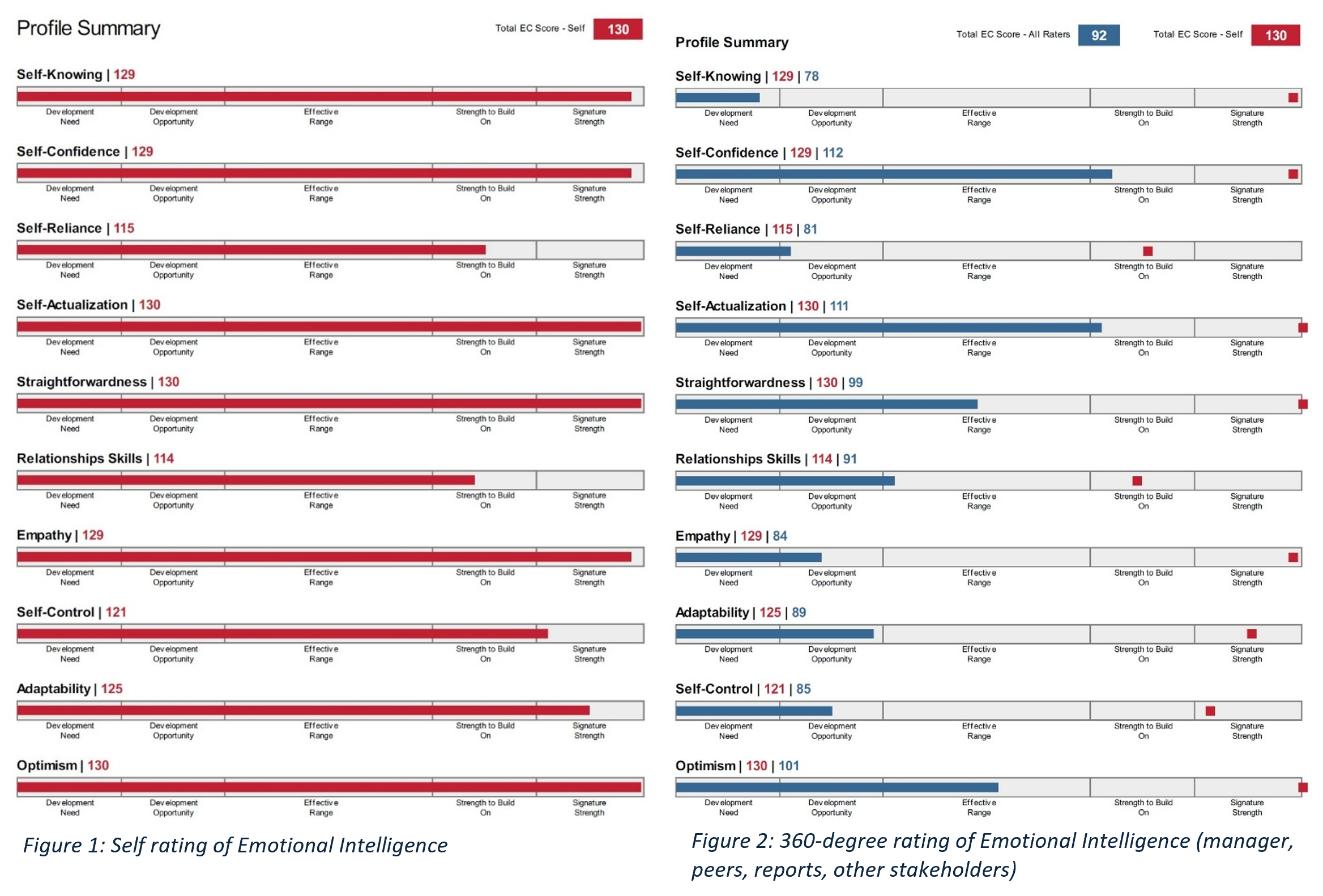
The chart on the left (figure 1, with the red bars) is a person’s self-rating of their Emotional Intelligence i.e. their opinion of how they rate their Emotional Intelligence.
Yes, this is a real (anonymised) Emotional Intelligence self-assessment from 2025.
The bold headings above each red bar are each of the 10 Emotional Intelligence Competencies that make up overall Emotional Intelligence e.g. Self-Knowing, Self-Confidence, Relationship Skills, Empathy, etc.
In this example, you can see the person has rated themselves as believing most (7 out of 10) of their EQ competencies are a ‘Signature Strength’ – as good as it gets - and the other 3 as a ‘Strength to Build on’.
With just the self-assessment to look at, this person seems to have an extremely high Emotional Intelligence – well, they certainly think they do!
However, as you can see, the 360-degree feedback on the right tells a very different story.
The chart on the right (figure 2, with the blue bars with the small red squares) is the 360-degree assessment of each of the person’s 10 Emotional Intelligence competencies – with the red squares indicating the person’s self-rating, for visual comparison.
The 360-degree assessment in this case was done by the person’s manager and senior leaders they dotted-line report to, the person’s peers, reports, and other stakeholders they work with.
Clearly there is a huge difference between the person’s self-assessment of their Emotional Intelligence and what their raters think:
5 competencies are rated as a ‘Development Need’ or ‘Development Opportunity’ - the exact opposite end of where the person’s rated themselves!
Does that mean this person is overconfident? Arrogant? Self-centred? A narcissist or psychopath? Illusory Superiority bias? Dunning-Kruger Effect? Better-than-average heuristic?
Could be any or all of the above.
While the narcissist label may come to mind, this self-rating profile summary does not necessarily mean the person is a narcissist, psychopath, or Machiavellian.
It most likely means the person has significant blind spots or is genuinely naïve and has absolutely no idea of how their behaviour comes across and impacts others – simply a deep lack of Emotional Intelligence.
In any case, clearly there’s some work to do getting this person to see where there are gaps in how they perceive themselves and how they actually come across to others, and that there are clearly behaviours that need to change – which can be extremely confronting for the person to realise.
All reasons why we strongly recommend 1:1 coaching to support any 360-degree assessment^.
I’ve seen so many situations where people have had a 360-degree assessment without coaching and where it’s been very damaging.
Without supporting coaching, people see there’s a ‘problem’ but have little idea what to practically do about it, so nothing changes. In many cases, it causes more problems.
It can really knock a person’s self-confidence and mental health, and people can withdraw and become very disengaged.
I’ve also seen people get very defensive and angry, and even go on ‘witch hunts’ to find out who said what - and even try to exact revenge.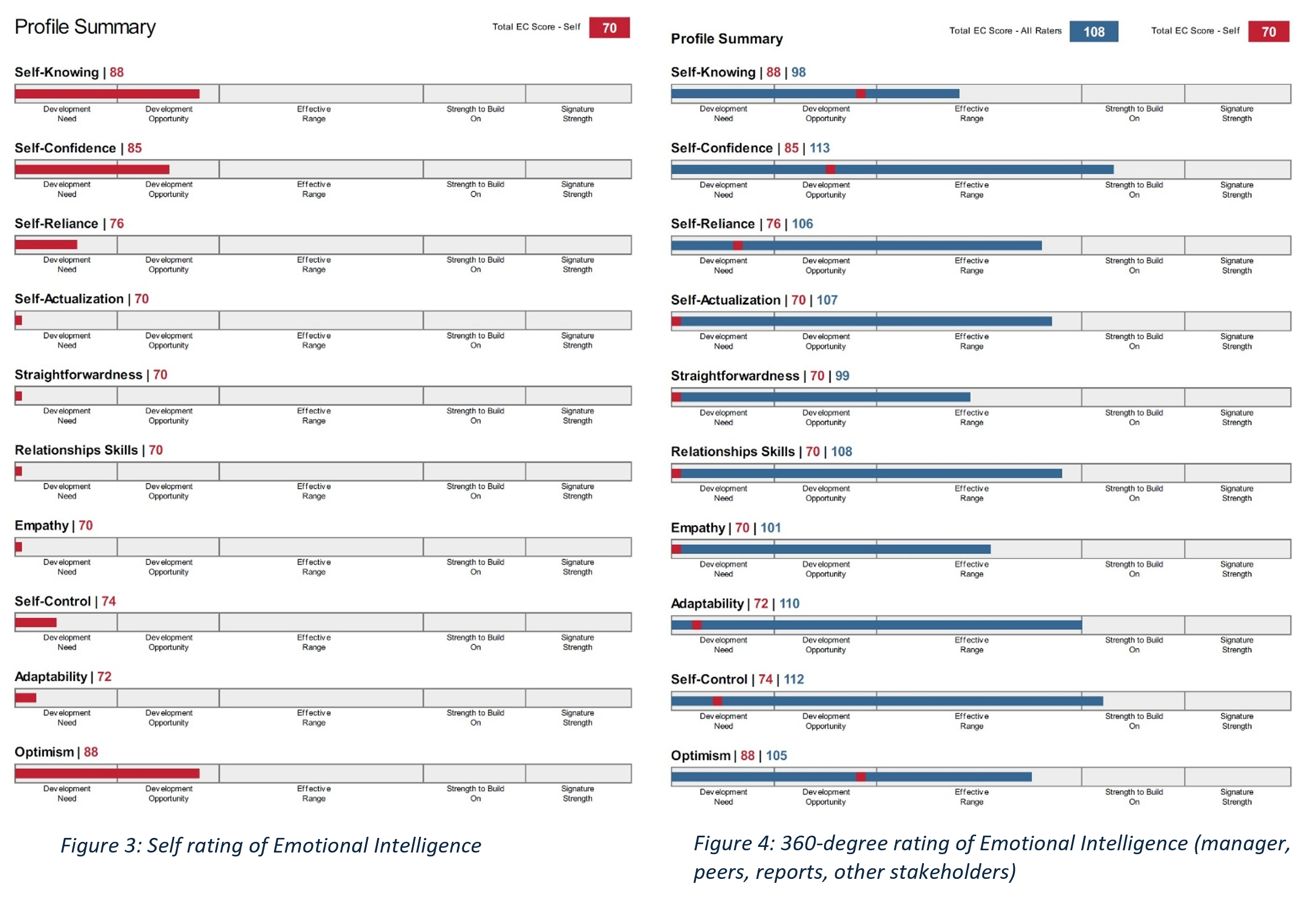
s you can see, the person has vastly underrated themselves compared to the 360-feedback.
Modest? Underconfident? Imposter Syndrome? Machiavellian? Again, it could be any of the afore-mentioned, all of these things could be factors.
Again, there’s clearly some work to do getting this person to realise they come across much more positively than they perceive themselves and that there are many strengths that they can build on.
You may think when people learn that their raters actually see them at a higher level than they perceive themselves that this is a ‘no-brainer feel-good moment’…not always. It can also be extremely challenging for the person receiving the feedback for a number of reasons.
Sometimes people simply don’t believe it, often due to lack of confidence or self-belief. Sometimes they feel an overwhelming pressure because they deep down don’t feel good enough and don’t think they can do anything about it and actually change behaviours.
More reasons why we strongly recommend supporting 1:1 coaching with any 360⁰ assessment^.
While the reports in figures 1-4 are more extreme examples, in the thousands of Emotional Intelligence 360-degree assessments Southern Cross Coaching & Development has done over the years it’s extremely rare for a self and 360-degree assessment to match up – it’s definitely the exception rather than the rule.
Which is why we recommend you don’t waste your money on self-assessments, and recommend you do a 360⁰ assessment to get the full picture.
With 1:1 coaching support^, of course!
If you’re interested in running an in-house 360⁰ assessment and Executive Coaching Program for any or all of your team – or for yourself - then click here to get in touch or click on the button below.
^5 reasons why 1:1 Coaching is so effective at embedding real behaviour change:
1. We cannot suddenly get rid of neural connections and pathways. For new learning to occur, we need to create new connections and pathways in our brains, and build on and make those strong – and stronger than the old habits so the new habits become the default and override the old habits.
2. Coaching is usually spread over a period of months so allows constant reinforcement of learning over a longer period creating stronger neural learning and habit-building pathways.
3. Coaching brings psychological safety and positive reinforcement which also strengthen neural learning and habit-building pathways.
4. Coaching empowers the coachee to do a lot of their own thinking and come up with their own answers – which is much more powerful at changing behaviour and thinking than telling someone what to do.
5. Coaches ask questions that help coachees have often deep insights – insights are those ‘ah-ha’ moments, which also create deep and strong neural learning and habit-building pathways to build on.

Published by
About our partner
Southern Cross Coaching & Development
2025 Best Training & Development Program award, Defence and National Security Workforce Awards Australia; 2025 Mentor of the Year, Gold Titan International Awards; Finalist Training & Mentoring Program of the Year, Australian Defence Industry Awards (national).NEUROSCIENCE-based.Leadership and People Development training, Executive Coaching (also with 360-degree assessments), Emotional Intelligence, Change Management and Resilience, and more. Job Application and Interview Skills training. Panel Recruitment Skills Training.Highly practical, extremely down to earth, individualised. ALL of our programs translate directly into real life action and results.30% INCREASE IN PRODUCTIVITY: that's what our clients tell us our innovative, but super-simple TOAD (TM) Coaching Leadership tool has achieved! Ask us about it, we’re happy to come & talk to you to discuss it. 26% INCREASE IN PRODUCTIVITY: That's what Gartner told us our Giving and Receiving Feedback program produced for a large NSW Government department.We deliver solutions from a single training or coaching program to multi-site, multi-team programs across Australia and the Asia Pacific Japan region.SES & Executives, Middle Managers, Managers through to Front Line Staff.📨: [email protected] 📱📞 +61 2 7901 5618 🌐www.southerncrosscoaching.com.au For our Coaching Assignments, we have our unique Coach/Coachee Matching Matrix. We've never got a coach/ coachee match wrong since we started using our unique Coach/Coachee Matching Matrix in 2007!We are specialists in neuroscience-based Coaching Culture Leadership. Our clients tell us our innovative but super-simple TOAD (TM) Coaching Leadership tool is revolutionary and makes a real difference in the workplace (and at home!).Full Qualification Status - NSW Government Pre-qualification Scheme SCM-0005: Performance & Management Services. Supplier for Department of Defence (DLB and DSTG across the ADF, APS/ EL1-2 and SES).
Learn more





Help your peers
Share what you've learned with fellow public servants