
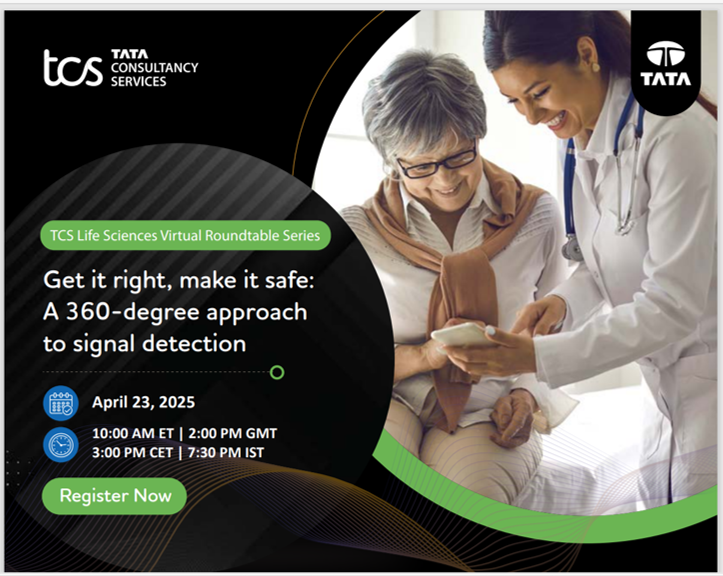
Traditionally, safety signals are detected either qualitatively or quantitatively. Qualitative detection involves a deep analysis through manual assessment of the individual case safety reports (ICSRs) in an individual or a cumulative manner, whereas the quantitative methods involve multiple statistical approaches. Varied sources, multiple datasets, different signal detection platforms, variability, and reporting requirements make it challenging to drive the safety signal detections. Advanced analytics and artificial intelligence (AI) technologies have the potential to transform the earlier methods of safety alerts detection and validation. This can help improve the efficiency and precision of drug monitoring and surveillance. Join this roundtable to explore innovative levers with digital technologies that can transform signal detection and management in pharmacovigilance: • Elevate safety surveillance: Use of natural language processing (NLP) in reading, interpreting, identifying, and alerting potential safety signals, monitoring social media efficiently by detecting trends and augmenting qualitative and quantitative analysis including the use of predictive analytics. Also, it enables earlier detection of safety signals through AI-driven multi-modal signal detection. • Regulatory compliance: Statistical interventions, NLP, AI, and generative AI (GenAI) can play a crucial role in enhancing regulatory compliance to demonstrate that data mining methods are transparent, reproducible, and compliant to ensure overall credibility.


Published by
About our partner
Tata Consultancy Services (TCS)
Tata Consultancy Services (TCS) is the technology partner of choice for industry-leading organizations worldwide. TCS was recently ranked the #1 most reliable IT services company by Newsweek, and has set an aspiration to become the world's largest AI-led technology services company, enabling clients to transform themselves across the full AI stack, from infrastructure to intelligence.The demand for government agencies across the US to adapt to changing expectations, policies, and technologies has never been greater. State and local governments need a partner committed to helping them adapt, improve efficiency, and deliver better services to people and businesses. Perpetual adaptation begins with understanding government's unique needs and a joint commitment to success. People deserve government that is there when they need it, the way they need it. Let's partner to deliver transformational change.
Learn more



Help your peers
Share what you've learned with fellow public servants