

Delays are frustrating. Uncertainty is expensive. When planning workflows are fragmented, the cost isn’t just internal admin time, it becomes stop–start RFIs, unpredictable timelines, duplicated enquiries, and rework loops that increase holding costs and deter investment. Because approvals are sequential, friction at one stage doesn’t stay contained; it compounds through every stage that follows, shaping delivery timing and confidence across the system.
This article explores how fragmentation extends beyond council operations into the broader approvals‑to‑delivery chain. It then outlines treating planning and delivery as connected civic infrastructure, coordinated workflows, shared standards, and end‑to‑end visibility that reduce rework, strengthen accountability, and improve throughput at scale.
Roadblock 3: The impact extends beyond council operations
Fragmentation doesn’t just slow councils, it creates time uncertainty for applicants: more stop–start RFIs, more rework, and less predictable timelines, which drives holding costs and deters investment. In New Zealand, statutory consent timeframes are often framed around 20 working days, but the clock can be paused when additional information is requested, a useful analogue for how fragmented processes turn delay into cost.(15)
The Productivity Commission notes governments’ target pace of 240,000 homes/year under the Accord versus ~176,000 homes built in the 12 months to June 2024, underscoring the need for faster, more coordinated throughput across planning and delivery.(14)
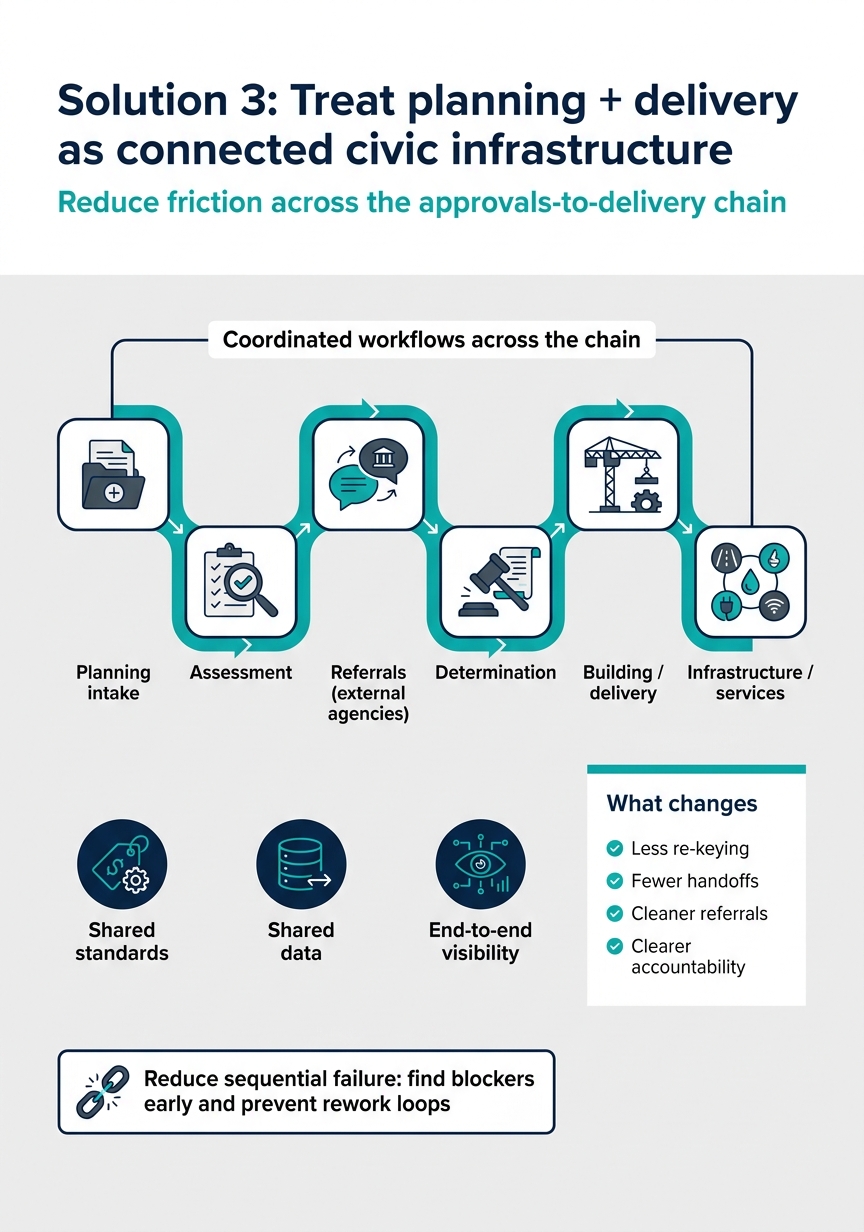
Solution 3: Treat planning + delivery as connected civic infrastructure
At a system level, improving planning throughput means reducing friction across the entire approvals-to-delivery chain, not just optimising individual steps. That requires coordinated workflows, shared standards, and end-to-end visibility across the agencies and functions that collectively shape housing outcomes.
Connected planning capability changes everything: one end-to-end workflow, one shared dataset, and one auditable evidence trail, from intake to determination. That means less re-keying, fewer handoffs, cleaner referrals, faster decisions, and clearer accountability:
- Coordinate across the chain: align planning, engineering, building, infrastructure, and external referral pathways so dependencies are explicit and handoffs are designed (not improvised).
- Adopt shared data standards: define a consistent core dataset (application, site, plans, constraints, referrals, conditions, determinations) so information can move cleanly between systems and parties.
- Build end-to-end visibility: provide a single view of status, blockers, and next actions across sequential approvals to reduce duplicate enquiries, rework, and hidden queue time.
- Reduce “sequential failure” effects: identify critical path dependencies early and remove avoidable rework loops (for example, missing information, late referrals, unclear conditions) that cascade delays into downstream delivery.
Across these four articles, one theme holds: better outcomes don’t come from pushing harder, they come from building connected capability that gives planning teams clean handoffs, shared data, and an auditable evidence trail. The full white paper pulls the complete narrative together and includes the gated sections designed to help leaders act: the consolidated conclusion, plus the business-case pathway and evidence pack materials used to scope and govern change.
Access the full white paper to get the complete framework and the practical “how-to” components that sit behind it.

Published by
About our partner
Objective Corporation
Objective Information Intelligence empowers government organisations to take complete control of their information, reducing risk, ensuring compliance, and unlocking the full value of their data. All without disrupting how teams work.Seamlessly connect to your existing systems to automatically enforce governance, maintain security, and optimise information for modern technologies, including AI solutions such as Microsoft Copilot and private RAG implementations.From secure collaboration and records management to information sharing and compliance, Objective Information Intelligence simplifies how your organisation manages and leverages information, driving transparency, stronger compliance, and greater efficiency across every department.With Objective Information Intelligence, your organisation gains a trusted foundation for defensible, AI-ready information, helping you make confident, data-driven decisions while maintaining complete control.
Learn more



Help your peers
Share what you've learned with fellow public servants