
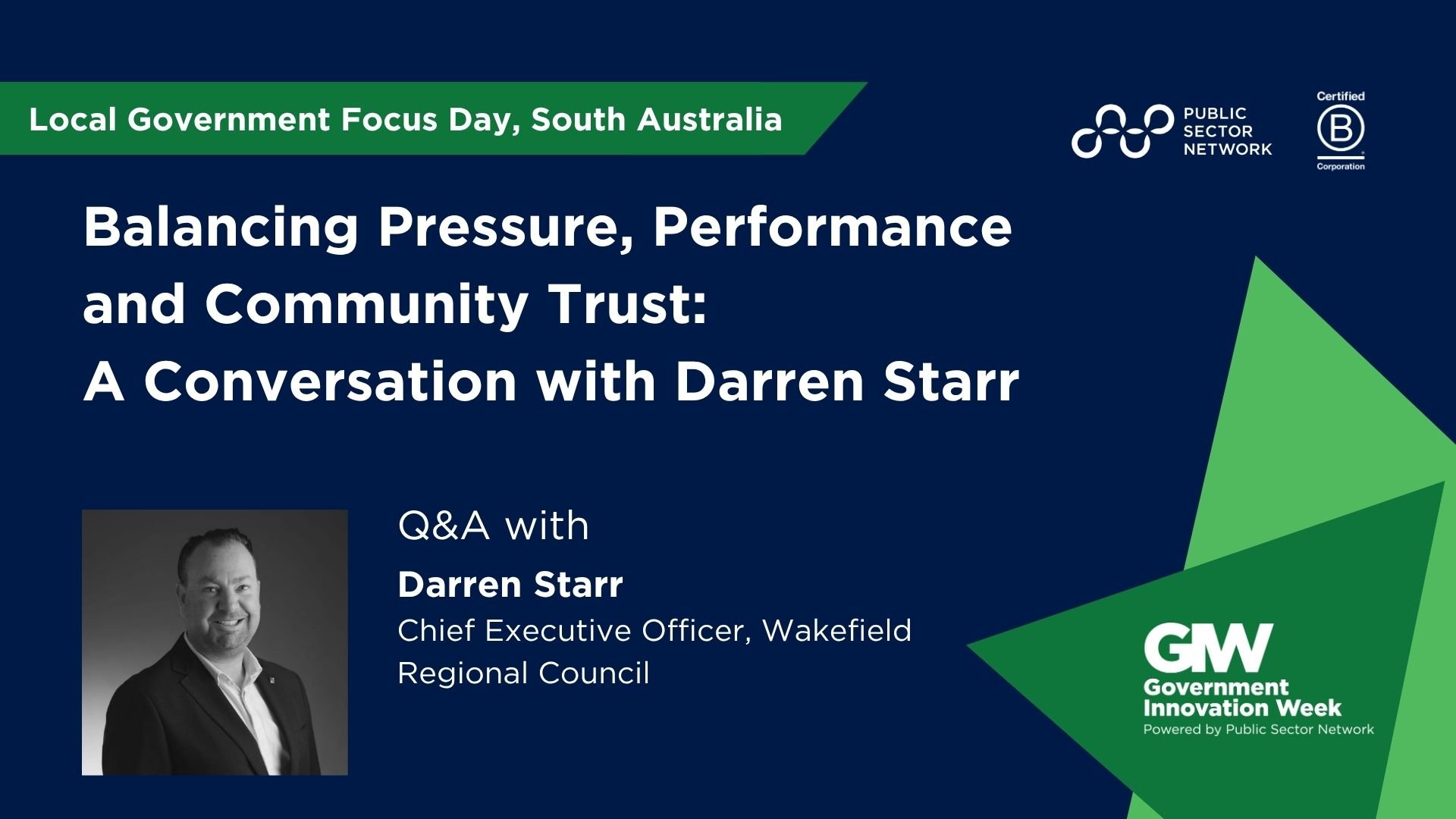
Local government leaders are being asked to do more with less, while managing rising expectations, tighter scrutiny and growing operational complexity. In this Q&A, Darren Starr, Chief Executive Officer, Wakefield Regional Council, reflects on how councils can lead with clarity under pressure, from making disciplined budget decisions and communicating operational reality, to building collaboration models that actually work. Ahead of Local Government Focus Day South Australia 2026, Darren also shares why strong governance, consistency and community understanding matter more than ever in maintaining trust and performance.
Public Sector Network:
When you’re facing budget constraints and cost shifting, what’s the first principle you use to decide what not to do, so service cuts don’t quietly erode community trust?
Darren Starr:
It starts with knowing your community and understanding what matters most to them. It is also important to provide clear, easily understood information about the services council provides and how those services are funded, which is something we do not always give enough attention to as local government professionals.
For most people, their only direct interaction with council finances is paying their rates. They are not reading annual reports, budgets, long-term financial plans or council reports. They focus on rates going up and the relatively small number of services they personally use.
That is why it is so important to clarify what local government provides to the community, whether an individual uses those services or not, and what those services cost for people willing to engage with the detail.
It is also important to push back strongly on cost shifting where there is a choice. At Wakefield Regional Council, we recently declined to participate in a program that only offered two years of funding and was framed around building local government capacity. We saw that as a clear cost-shifting exercise, and we were clear that this was the reason we declined.
Hear Darren Starr at Local Government Focus Day South Australia 2026 in the panel discussion Leading Under Pressure: Navigating the Challenges of Modern Local Government.
This session will explore how councils are managing budget constraints, cost shifting, rising expectations, reform pressures and collaboration while maintaining trust, performance and community impact.
Register here: https://psnevents.eventsair.com/local-government-focus-day-south-australia-2026/gov/Site/Register
View the agenda: https://publicsectornetwork.com/events/government-innovation-week-south-australia-adelaide-2026/local-government-focus-day-south-australia-adelaide-2026/agenda/
Public Sector Network:
Community expectations keep rising. What are the most effective ways you’ve found to communicate operational reality transparently without sounding defensive or diminishing residents’ concerns?
Darren Starr:
I’m a strong supporter of using a $100 budget infographic, or something similar, to explain council spending in plain language and show where the money actually goes, whether that is roads, public spaces, services or infrastructure.
It gives people a baseline understanding and allows councils to be transparent without diminishing community expectations or concerns. When people can clearly see how council expenditure is allocated, the conversation becomes more grounded and constructive.
Public Sector Network:
Collaboration is often talked about but hard to execute. What are one or two practical collaboration models you’ve seen work between councils, and what made them succeed?
Darren Starr:
One example is the Regional Public Health Plan across Adelaide Plains, Barossa, Gawler and Light. What made this model effective was that it moved beyond a business-as-usual approach into a project-focused delivery model. Each council took responsibility for a defined action with a clear outcome.
Implementation was guided by a steering group made up of both staff and elected members from all four councils, which ensured shared ownership and alignment at both council and operational levels.
A second example is the Eyre Peninsula Regional Assessment Panel, which I have been involved in since its inception. This panel acts as the relevant planning authority for specific development applications across ten councils. Instead of each council needing to recruit and retain accredited professionals and maintain its own panel, a single regional panel and assessment manager oversees the function across the region.
That scale delivers consistency and professional expertise that would be difficult for smaller councils to achieve on their own. The fact that the panel is approaching its sixth anniversary is, in itself, a strong indicator of success.
Public Sector Network:
Leading under pressure can force faster decision-making. How do you maintain governance discipline, around risk, probity and compliance, while still moving quickly when the spotlight is on?
Darren Starr:
For me, it starts with recognising that governance processes exist to support good decision-making, not to slow it down. Risk, probity and compliance are not value-adds that you turn on when time allows. They are integral to making strong decisions that stand up over time.
Making the wrong decision quickly does not help anyone, and in practice it almost always creates more cost, financially, reputationally and organisationally, down the track.
When pressure is high, the discipline is being very clear about what information is genuinely required to make a decision, and collecting that efficiently. There is an important distinction between gathering what is necessary to understand risk and options, and continuing to gather data in the hope that the decision will somehow make itself.
As CEO, part of the role is knowing when there is enough information to proceed responsibly. Maintaining governance under pressure is about confidence and clarity — confidence in the frameworks we have in place, and clarity about roles, risks and accountabilities. When those foundations are sound, councils can move quickly without cutting corners.
Register here: https://psnevents.eventsair.com/local-government-focus-day-south-australia-2026/gov/Site/Register
Explore the full speaker lineup: https://publicsectornetwork.com/events/government-innovation-week-south-australia-adelaide-2026/local-government-focus-day-south-australia-adelaide-2026/speakers/
Public Sector Network:
For delegates in the room, what is one action you’d recommend they take in the next 60 to 90 days that would most improve performance and trust, despite tight resources?
Darren Starr:
The one action I would recommend is making a commitment to consistently model the performance and behaviour you expect from others.
Trust is not built in a 90-day window. It is built every day through consistency. It takes a long time to earn and very little time to lose. That means performance and trust improve through repeated, observable actions.
As leaders, that starts with following through on commitments and applying the same standards to ourselves that we expect of our teams. If you consistently demonstrate respect, accountability and integrity in small, everyday decisions, you set the benchmark for the organisation.






Help your peers
Share what you've learned with fellow public servants