

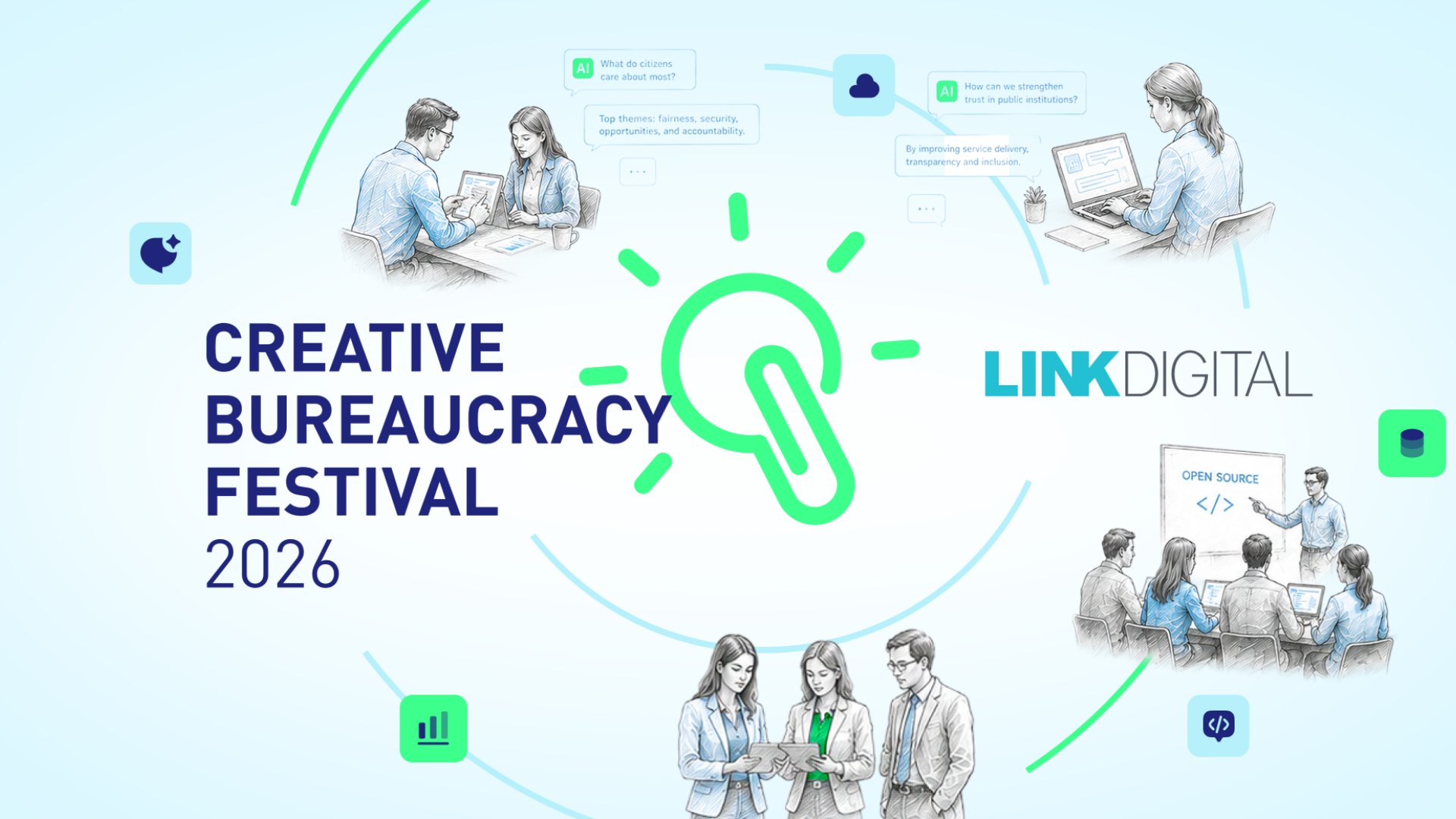
At the recent 10th Creative Bureaucracy Festival in Berlin, public sector leaders, innovators, and digital strategists gathered under the theme of "Creative Bureaucracy – Stronger Democracy." Amidst growing public dissatisfaction and the rise of populist movements across OECD nations, one central theme emerged as the ultimate defense against democratic erosion: Trust.
But how do governments define, preserve, and build trust in a modern, complex landscape? Here are the key takeaways for public sector professionals:
1. Effective Service Delivery is the Foundation of Trust
A prevailing sentiment at the festival was that governments do not lack ideas; they lack execution. Citizens increasingly feel that no single entity is "owning" or solving complex issues like AI integration. Building trust requires closing the gap between policy design and service delivery.
2. Open Source Technology and Digital Sovereignty
Citizens do not care which government agency provides a digital service; they simply want it to be reliable. Open-source technology offers crucial cultural and collaborative benefits, preventing different levels of government from wasting scarce resources to solve the exact same problems.
Furthermore, open-source technology is a critical driver of digital and data sovereignty, the right of states to control their digital futures. As highlighted by the EU’s recent European Technological Sovereignty Package, reliance on foreign tech giants creates vulnerabilities. Open-source solutions empower governments to build secure, locally governed software pipelines.
3. Moving Beyond Assumed Trust: Trust as an Engineered Property
Is efficient service delivery alone enough to win back public confidence? Link Digital proposes a paradigm shift: in an era of fractured narratives and black-box AI algorithms, governments can no longer simply demand or assume trust. Instead, trust must be treated as an engineered, structural property.
This requires a commitment to causal continuity, the ability to transparently trace exactly how data is used and how conclusions are reached. Instead of treating data merely as a product for public "access," governments must build open, observable data pipelines. By allowing citizens to explicitly verify the intent, source code, and logic behind bureaucratic and algorithmic decisions, governments can build digital infrastructure with communities, rather than just about them.
The Bottom Line:
To stem democratic erosion, the public sector must evolve. Trust in 2026 and beyond relies on a combination of highly effective service delivery, collaborative open-source technology, and radically transparent digital infrastructure.
This article was originally published by Link Digital. You can read the full version of the article here:

Published by
About our partner
Link Digital
System architects of data and knowledge infrastructureFor 25 years, Link Digital has designed and run the information systems that governments, research institutions and international organisations depend on. We build open data portals and internal data hubs, host and support them, and now make them ready for people and AI to ask questions of. Founded in Australia in 2001, we work with clients worldwide, including Australia, Canada, New Zealand, the Pacific, and Latin America.Official CKAN co-stewardCKAN is a leading open source data portal platform, and Link Digital has been part of its community since 2012. Our Executive Director, Steven De Costa, and our engineers are involved across CKAN's governance, community and technical work, and our team includes the project's Core Tech Lead. We help shape the 2.12 and 3.0 roadmaps. For public sector buyers, that means open source with no vendor lock-in, and a partner with a say in the releases and long-term sustainability you will rely on.What we doAsk AI for CKAN. Ask questions in plain language and get verified answers drawn from your own data. It runs in your secure environment, never trains public models, and you control who can query which datasets. We start with an AI-readiness audit.End-to-end CKAN services. Consultancy, migration from legacy systems, hosting, support, extensions and theming, with DCAT and FAIR-aligned metadata.Managed hosting, support and maintenance. CKAN and Drupal on AWS infrastructure we architect and monitor, with security patch assessment, restore-verified backups and version currency. One team, one agreement, one invoice. We can take over portals built by others.Internal data hubs and Secure Data Exchange. Governed sharing across departments, with approval workflows, revocable data sharing agreements and a dashboard showing who is using your data.Custom CKAN and Drupal buildsStart a conversation with Link Digital: Book a consultation or request an AI-readiness audit.
Learn more


Help your peers
Share what you've learned with fellow public servants