

Australia's housing challenge is placing unprecedented pressure on planning teams to increase capacity, improve productivity and deliver approvals more efficiently. The natural response is to accelerate digital transformation by implementing a point solution to improve one part of the planning process, or introducing AI to automate an individual workflow. But when these investments are made without considering how planning work connects end to end, they can reinforce fragmentation rather than reduce it. Fragmented legacy environments create technical debt, inconsistent data and unclear ownership. Layering new technology over disconnected systems doesn't remove complexity. It often scales inconsistency, limits visibility and makes governance harder.
This article unpacks Roadblock 2: how legacy complexity absorbs time and budget that should be improving planning outcomes, and why planning systems cannot become truly AI enabled without stronger data discipline, integrated workflows and auditable decision pathways. It then sets out Solution 2: build digital competency and integration foundations first, then apply AI to the highest friction, lowest risk use cases, with humans remaining accountable for judgement and decisions.
Roadblock 2: Legacy complexity is limiting future capability
Fragmented, legacy environments create technical debt: time and budget get absorbed keeping disconnected architectures and data working, rather than improving planning outcomes. McKinsey & Company estimates technical debt can represent up to 40% of the average IT balance sheet, with substantial value trapped in outdated architectures, fragmented data, and legacy complexity.(5)
That direction aligns with the Australian Government’s data and digital agenda, which emphasises that strong data and integration foundations are prerequisites for connected, secure, user‑centred services, and for governing AI responsibly.(6) Without those foundations, AI adoption amplifies inconsistency and governance risk rather than reducing workload.
In planning, the impact compounds because approvals are sequential: delays and rework at one stage cascade into every stage that follows, alongside an expanding regulatory burden (including the National Construction Code now exceeding 2,000 pages).(14)
Solution 2: Build digital competency and foundations, then apply AI to priority use cases
AI won’t fix fragmented foundations. Local authorities need to lift digital competency and data discipline first, then apply AI to the highest-friction, lowest-risk use cases with clear governance.
A practical CTA is the Planning Institute of Australia’s Digital Planning Core Competencies (16), which councils can use as a maturity checklist:
- Understanding & data literacy: confident using data and digital tools in different contexts.
- Communication: leverage data and digital tools to improve communication and engagement outcomes.
- Organisational value: identify, improve, and lead adoption of digital technologies to deliver better value.
- Governance: enhance trust and integrity of planning in the application of digital technologies.
Once these foundations are in place, councils can prioritise AI where it reduces admin burden, improves consistency, and strengthens auditability (with humans accountable for judgement and decisions). (16)
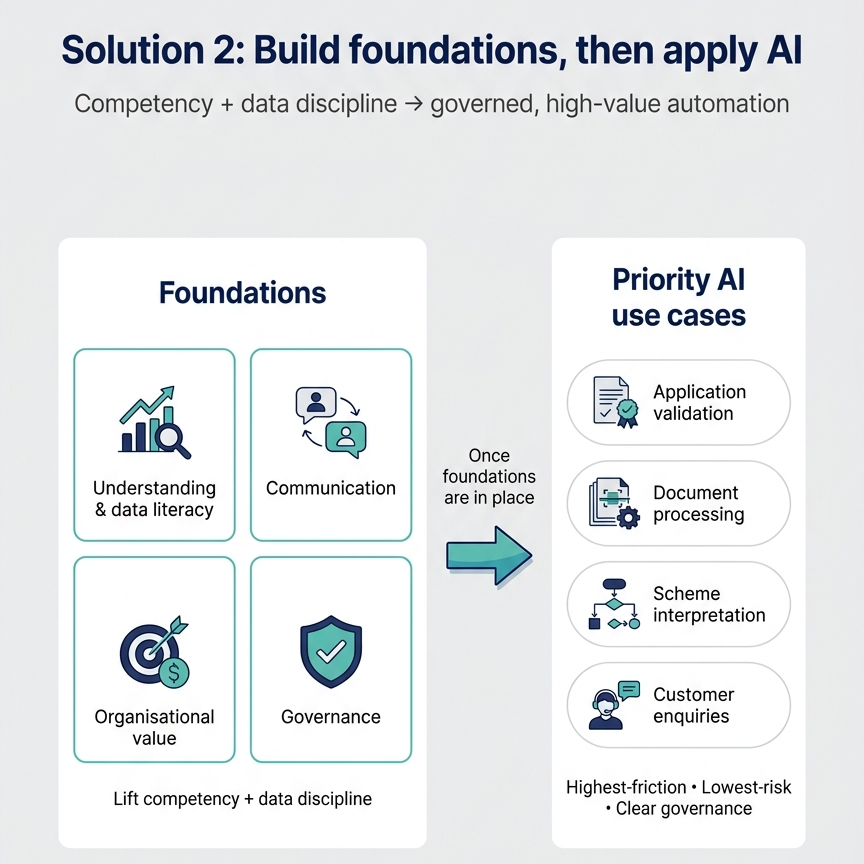
The Municipal Association of Victoria’s 2025 AI Planning Report suggests this shift is already underway.(9) Early council interest has centred on practical, lower-risk use cases such as customer enquiries, planning scheme interpretation, pre-application guidance, and permit application support. These are areas where AI can help improve application quality upfront, reduce avoidable back-and-forth, and make the process easier for both councils and applicants. Industry perspectives point to even broader potential. Housing Industry Association Executive Director Sam Heckel has described AI as a potential “circuit breaker” for Australia’s housing system, with the capacity to help deliver 1.2 million homes over five years by addressing planning bottlenecks.(10) Practical applications include reviewing documentation, supporting development application assessments, and completing post-submission checks before human intervention, helping to streamline workflows and improve transparency. Early pilots in New South Wales demonstrate that some approvals can now be processed in as little as two days, while AI applications in federal assessment processes could help reduce large backlogs.(10) AI is also expected to help unlock a backlog of up to 26,000 homes awaiting EPBC assessment, highlighting its potential to accelerate housing delivery at scale. |
Even when councils lift internal throughput, fragmentation still shows up where it hurts most: in time uncertainty for applicants and downstream delivery delays that cascade across the housing system. In the final article, we widen the lens to the approvals‑to‑delivery chain,and make the case for treating planning and delivery as connected civic infrastructure, designed for end‑to‑end visibility and coordinated handoffs.
Next up: the system-wide cost of uncertainty, and what changes when the chain connects.

Published by
About our partner
Objective Corporation
Objective Information Intelligence empowers government organisations to take complete control of their information, reducing risk, ensuring compliance, and unlocking the full value of their data. All without disrupting how teams work.Seamlessly connect to your existing systems to automatically enforce governance, maintain security, and optimise information for modern technologies, including AI solutions such as Microsoft Copilot and private RAG implementations.From secure collaboration and records management to information sharing and compliance, Objective Information Intelligence simplifies how your organisation manages and leverages information, driving transparency, stronger compliance, and greater efficiency across every department.With Objective Information Intelligence, your organisation gains a trusted foundation for defensible, AI-ready information, helping you make confident, data-driven decisions while maintaining complete control.
Learn more




Help your peers
Share what you've learned with fellow public servants