

Most councils do not have a planner effort or capability problem. They have a workflow problem. Across intake, assessment, referrals, RFIs, reporting and determination, planners are constrained by process friction: re-entering information, chasing missing documents, translating between systems, and manually coordinating steps that should operate as a single workflow. These aren’t headline issues in isolation, but at scale they become a capacity drain that slows approvals, increases rework, and pushes fatigue and retention risk higher at exactly the wrong time.
This article breaks down how labour‑intensive, fragmented processes reduce throughput across the planning function. It then turns to what it looks like to commission planner‑centred systems- not “digitised fragments”, but requirements that reflect real assessment flow, shared data captured once, and an evidence trail that strengthens defensibility while reducing admin load.
Roadblock 1: Labour-intensive processes are draining planning capacity
Disconnected planning systems create duplication, rework, and inefficiency across the entire planning function. Planners often re-enter data, move documents between platforms, track workflow manually, and chase missing information across systems that do not connect cleanly.
These may seem minor, but over time they slow assessment, increase rework, and consume capacity better used for higher-value planning work.
Even within a single DA or Permit (Development Applications and Permits), the time cost of “process work” is material. Recent practitioner timings provided by the Objective team (from council workflow observation) suggest the following average effort per application, before considering rework and delays:
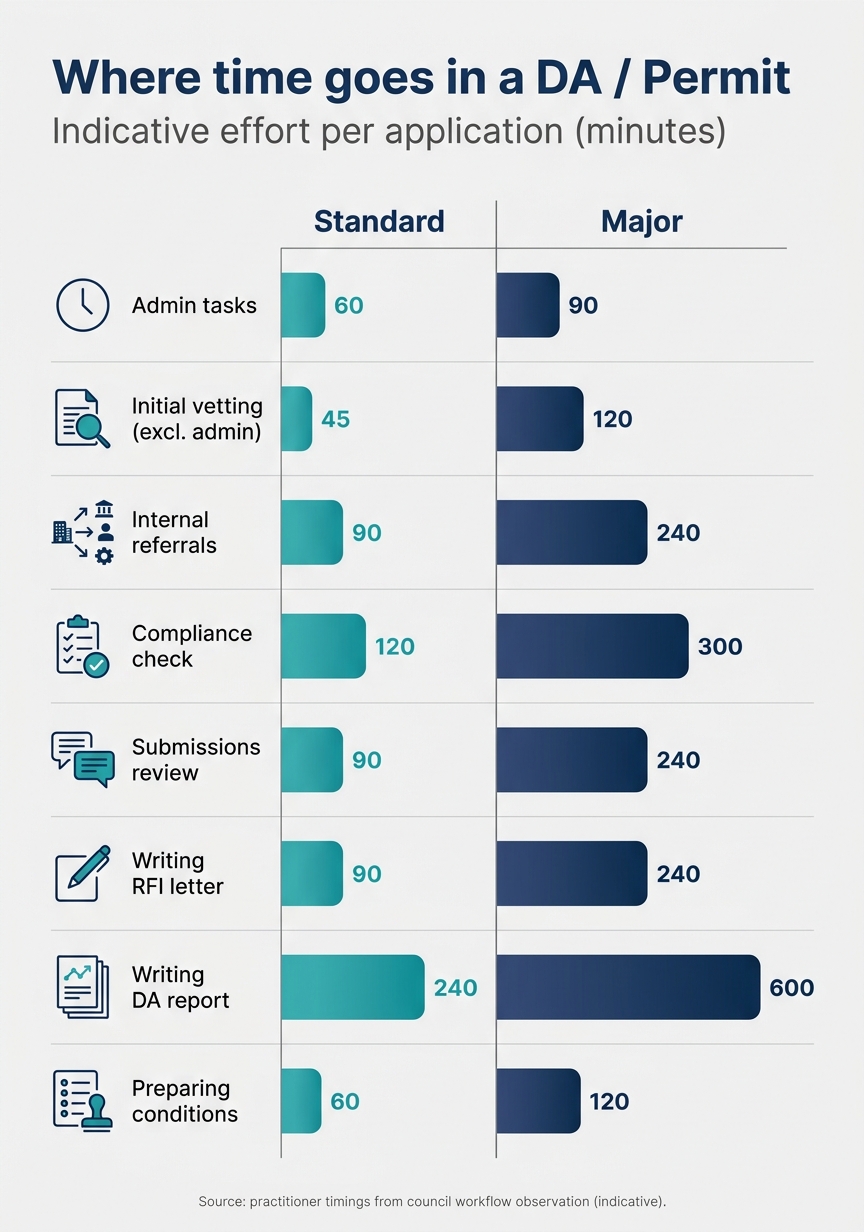
| These indicative timings are drawn from activity tracking and workflow observations provided by practising planners at Objective foundation partner councils (statutory planning roles). |
These inefficiencies matter because councils can’t simply “add capacity” through hiring. This challenge is compounded by a tightening labour market: the Planning Institute of Australia reports that 64% of organisations have struggled to fill planning roles in the past 12 months, with a lack of qualified candidates cited as the primary barrier.(2)
Solution 1: Commission Planner-Centred Systems
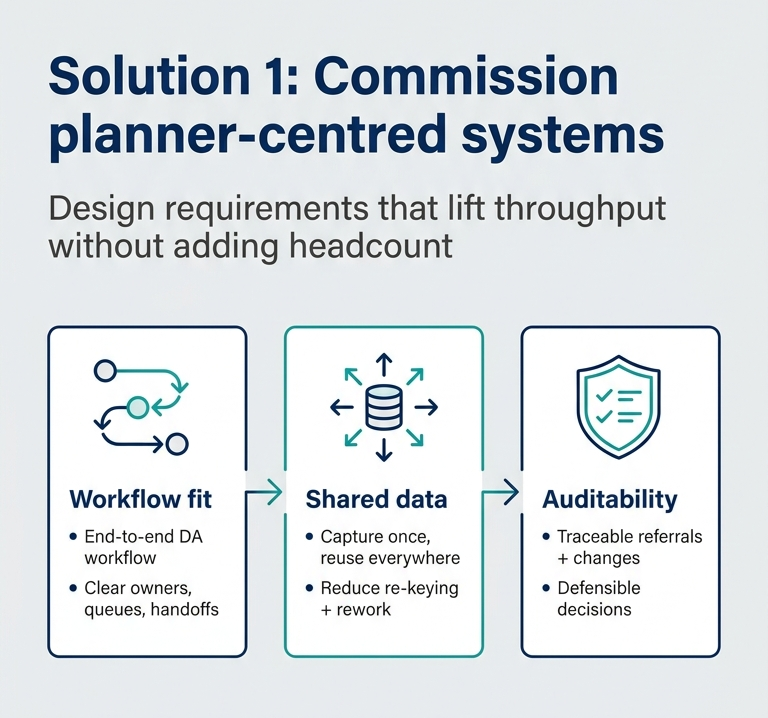
Planning directors aren’t designing software, but they do set requirements, sponsor change, and decide what gets adopted. Lifting throughput without adding headcount depends on empowering planning teams with planner-centred systems: end-to-end workflows that reflect real assessment, shared data captured once and reused, and an auditable evidence trail from intake to determination.
The Planning Institute of Australia’s PlanTech Principles reinforce the standard councils should hold: digital planning must support and enhance professional judgement, not replace it or force workarounds.(8) In practice, that means governing adoption of tools that simplify complexity, improve referral collaboration, and make it easier to apply current regulation consistently, rather than digitising fragmented steps and pushing integration back onto planners.
Fixing process friction can deliver fast wins, but many councils hit a ceiling when the underlying environment is still a patchwork of legacy tools and disconnected data. In the next article, we shift from workflow pain to the enabling layer underneath it: why legacy complexity limits future capability, why AI won’t rescue fragmented foundations, and the practical pathway to lift digital competency and governance before scaling automation.
Next up: foundations first, then AI where it actually helps.

Published by
About our partner
Objective Corporation
Objective Information Intelligence empowers government organisations to take complete control of their information, reducing risk, ensuring compliance, and unlocking the full value of their data. All without disrupting how teams work.Seamlessly connect to your existing systems to automatically enforce governance, maintain security, and optimise information for modern technologies, including AI solutions such as Microsoft Copilot and private RAG implementations.From secure collaboration and records management to information sharing and compliance, Objective Information Intelligence simplifies how your organisation manages and leverages information, driving transparency, stronger compliance, and greater efficiency across every department.With Objective Information Intelligence, your organisation gains a trusted foundation for defensible, AI-ready information, helping you make confident, data-driven decisions while maintaining complete control.
Learn more



Help your peers
Share what you've learned with fellow public servants