
ERP and digital transformation programs are usually judged on the strength of the tools an organisation invests in. Yet in my experience, the biggest threat to getting value from automation is rarely the tool itself. It is the process we ask the tool to automate.
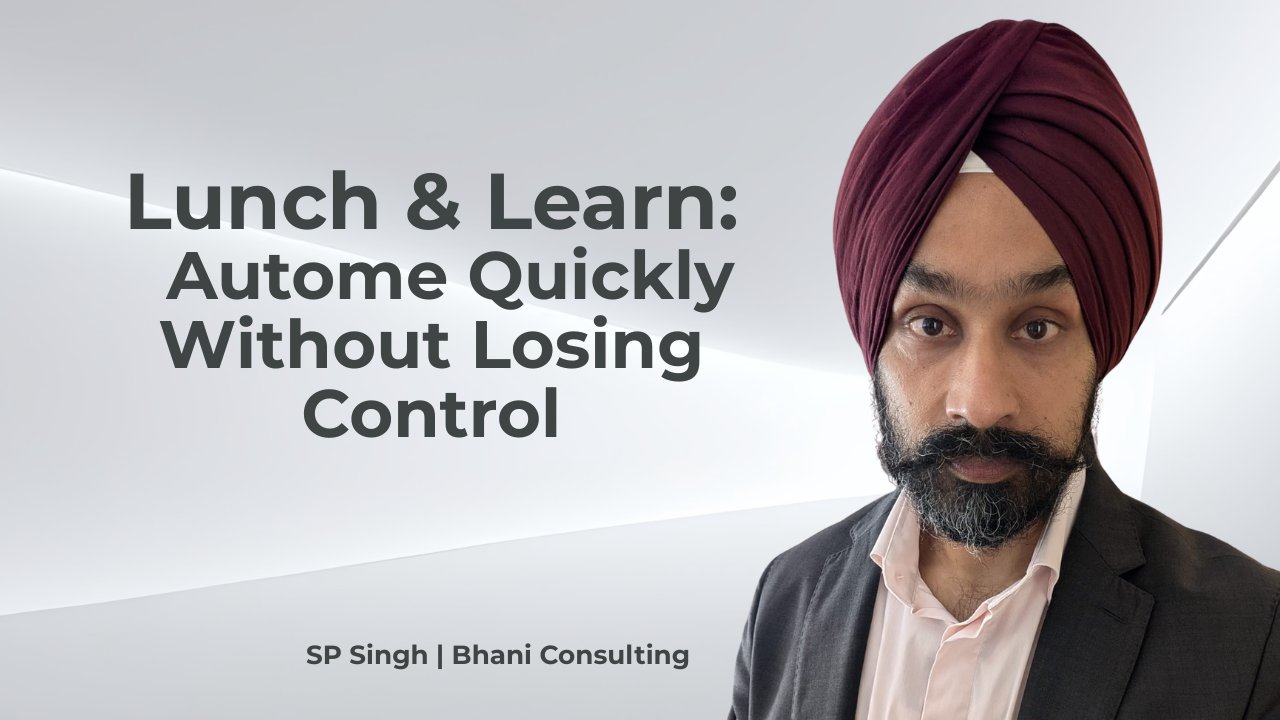
This was the focus of my recent Bhani Consulting Lunch & Learn session, Automate Quickly Without Losing Control.
The session explored a simple but often overlooked idea: automating a messy process doesn't remove the mess. It speeds it up. I used a familiar example, an accounts payable invoice approval process where invoices arrive in several inboxes, purchase orders are raised after the fact or not at all, approvals are ad hoc and disputes live in spreadsheets. Automate that process, whether through AI, workflow or an ERP, and you get invoices that don't match, approvals routed to the wrong people, duplicate suppliers and new workarounds. All that effort simply increases the velocity of messiness.
A key theme throughout the discussion was the Automation Ladder, six steps that each need to be completed before moving to the next: understand the problem and context, simplify, identify the right candidates for automation, execute, embed the change with the people who will use it, and close and hand over to the business. In practice, most organisations jump straight to identifying candidates and executing. The steps that make automation work, simplifying first and embedding afterwards, are the ones most often skipped.
The session also introduced four elements of simplification. Eliminate the options, edge cases and once-in-a-blue-moon scenarios that have built up over the years. Allocate one owner for each process, each set of data and each system, so decisions can be made quickly. Keep one source of truth for each type of master data. And improve the process by limiting the decision loops that bounce work between teams. In the invoice example, seven invoice types and twelve approval exceptions became two invoice types and one queue, with finance owning the process and procurement owning supplier data. We also looked at how AI can be used to simplify, not only to automate, and how to measure whether a process is actually getting simpler: fewer steps, shorter cycle times, fewer exceptions, and a process people can explain on one page.
The discussion challenged the assumption that AI makes simplification optional. When a process feels too slow and too political to fix, our default response is to automate what we have, and AI makes that even more tempting. Attendees added valuable perspectives: decisions made through workflows or AI must stay traceable, with clear information ownership, especially as privacy requirements tighten; and poor data in now produces far more poor output, because AI amplifies whatever it is given.
For public sector leaders, this perspective is particularly relevant as councils prepare for ERP replacements in the coming years, many with automation and AI built into the platform. As one attendee noted, smaller councils often have one person wearing many hats, which makes it harder to give process owners the time they need. Planning that commitment up front, making it visible and replanning when things change, can protect both the project and day-to-day operations.
The session reinforced an important message: automation is part of process improvement, not a goal in its own right. It is not about which tool or which AI. It is about the discipline to simplify, to agree business rules and to make sure people follow them.
As automation and AI become part of every system, the ability to simplify first, rather than automate whatever is already there, will become an increasingly important capability for public sector leaders. That journey involves real business change, so the best place to start is with executives: explain up front that this is not IT magic but business change supported by technology, and get their endorsement before the work begins.

Published by
About our partner
Bhani Consulting
At Bhani Consulting, we provide 100% independent and software-agnostic consulting services that take a holistic approach to Business system implementations. Our team is with you every step of the way, whether you're starting from scratch or upgrading existing systems. We are trusted partners who lead from the front and provide support throughout the process.Our proven track record of transforming businesses and achieving growth speaks to our success in streamlining processes and improving the customer experience. We understand the challenges of automating business processes, including systems selection and implementation.
Learn more



Help your peers
Share what you've learned with fellow public servants