

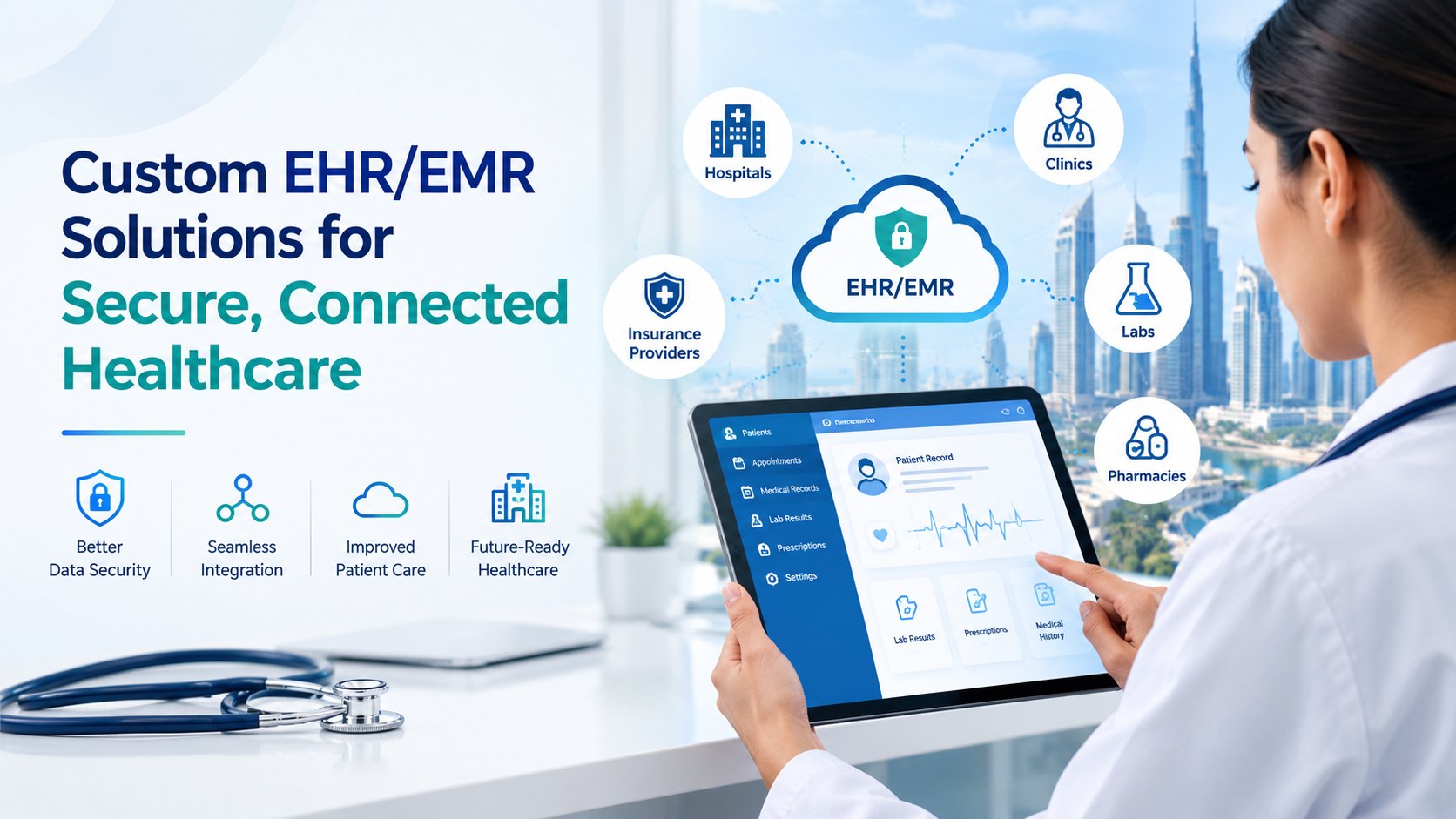
A patient’s medical history could be held in dozens of places from hospital records to lab reports, pharmacy apps and diagnostic platforms. When these systems aren’t communicating effectively, healthcare professionals may not have the full picture before making clinical decisions. Also, the burden can be increased by repeated data entry and missing records.
This gap means that healthcare providers in the UAE will need to do more than simply store digital records. Custom EHR/EMR development UAE can connect your existing healthcare applications, improve the flow of patient information and help clinical teams in their day-to-day work. The real value is giving the right data, where and when it’s needed, in a reliable, relevant way.
Why Healthcare Data Integration Needs a Different Approach
A hospital may use separate applications for consultations, laboratory tests, prescriptions, appointments, and billing. Replacing every application is not always practical. In many cases, connecting the systems already in use is a more suitable starting point.
Custom EHR/EMR software can provide these connections while allowing healthcare teams to retain workflows that work for them. An integrated system might transfer laboratory results into a patient’s record or make updated medication information available to authorised clinicians.
This is where EHR/EMR integration UAE becomes particularly relevant. Standards such as HL7 and FHIR help applications exchange structured healthcare information, but developers must also ensure that the receiving system interprets the data correctly. A successful connection is of little use if records are incomplete, duplicated, or assigned to the wrong patient.
What UAE Healthcare Providers Need to Consider
The UAE has established health information exchange platforms to support the sharing of medical information across healthcare networks. NABIDH operates in Dubai, Malaffi serves Abu Dhabi, and Riayati supports the national unified medical record initiative.
It’s more than just putting an interface on top of existing software to connect to those platforms. For successful Custom EHR/EMR development UAE implementations, healthcare providers need to consider technical specifications, data requirements, permissions and approval processes.
A tailored system can help address these requirements, but compliance should never be assumed simply because the software supports data exchange. The proposed integration must be checked against the relevant authority’s current requirements.
Where Custom Integration Makes a Practical Difference
The real-world value of HL7 and FHIR integration becomes much clearer when applied to everyday hospital operations.
- Patient records- Authorized healthcare providers may access relevant medical histories, allergies and prescriptions through connected systems.
- Lab reporting- Results can be transferred electronically to eliminate the need for staff to locate and upload reports manually.
- Administrative workflows- Tying clinical apps to billing or appointment systems can cut down on duplicate data entry.
- Information Security- Encryption, audit logs, and role-based permissions protect sensitive records and track system activity.
- Future upgrades- The flexible architecture makes it easier to plan for future integration as a provider’s operational needs evolve.
These results are dependent on accurate data mapping, reliable connections, staff training and testing. Customization is not a fix for bad data quality or inconsistent record keeping practices.
Planning the Right Integration Strategy
Before development begins, healthcare organisations should identify which systems need to communicate and what information each connection must exchange. Reviewing existing applications, patient identifiers, access permissions, and data formats can reveal problems before they affect live operations.
A well-planned Healthcare data integration UAE project should also include testing for missing records, duplicate entries, failed transfers, and unauthorised access. Providers must establish how integration errors will be monitored and resolved after launch.
Working with a healthcare software development partner can help organisations assess these technical requirements and plan hospital management system integration around their clinical and administrative workflows.
Conclusion
Healthcare data becomes more useful when it can move reliably between the systems that depend on it. For UAE hospitals and clinics, the priority is to build connections that improve access to information without creating new risks or unnecessary complexity.
With proper planning, Custom EHR/EMR Development UAE can create a more connected healthcare environment. The starting point is not to add more software but to understand where information gets stuck and to devise a secure, practical way to move it.

Published by
About our partner
Seasia Infotech
Seasia Infotech is a CMMI Level 5 certified global technology company specializing in custom software development, AI and machine learning, web and mobile application development, cloud solutions, enterprise software, QA and testing, DevOps, UI/UX design, and digital transformation. With over 25 years of industry experience, we help startups, SMEs, and enterprises build secure, scalable, and innovative technology solutions. Our experienced team has successfully delivered thousands of projects across industries including healthcare, fintech, retail, logistics, real estate, manufacturing, and education. We are committed to delivering high-quality solutions, agile development, and long-term client partnerships.
Learn more


Help your peers
Share what you've learned with fellow public servants