
We talk constantly about the importance of people in transformation. What I observe in the organisations we work with is that we rarely treat them as having any agency in it. The future of work gets discussed as something being done to the workforce, rather than something the workforce is actively building.
Some of that is simple comfort. Technology is broadly predictable. It responds to instruction, and it does not require you to be polite on a bad day. People are unpredictable, they do not always do what the change plan assumes, and so the conversation drifts back to the platform, where the ground feels firmer.
DLPA was recently shortlisted for the AFR Most Innovative Company awards. In a room of roughly 300 organisations, ours was the only entry whose solution was not AI-based. It was systems-based. The work on display was genuinely impressive, and Australia punches above its weight here. But almost every success was narrated through the technology lens: this is the AI we built, this is the solution we shipped. Very little was narrated as changed lived experience. Which user story, from a human vantage point, is actually different now?
If people are our greatest asset, the fair test is how often transformation is designed with them at the heart: as the people who roll it out, and as the people who live with it. That conversation is shifting, but the elephant in the room remains. Not every worker has capacity for change. Not every worker has capacity for growth. AI will leave a portion of the population behind, whether we intend it or not. This makes deliberate attention to the human side of change both an organisational obligation and a societal one.
The readiness nobody maps
Innovation and technology have become conflated. A great deal of innovation uses technology as a tool, but the technology itself is not the innovative part. The system or the thinking is. That is a distinctly human contribution, and we give it away far too freely.
Every transformation lives or dies on human belief and behaviour. Without genuine willingness, you can change a process, but residual friction will remain, because people transform processes. Processes do not transform people. We often observe that transformation has no defined end point. The way to fix that is to ask what human outcome we want at the end, and let that define the roadmap.
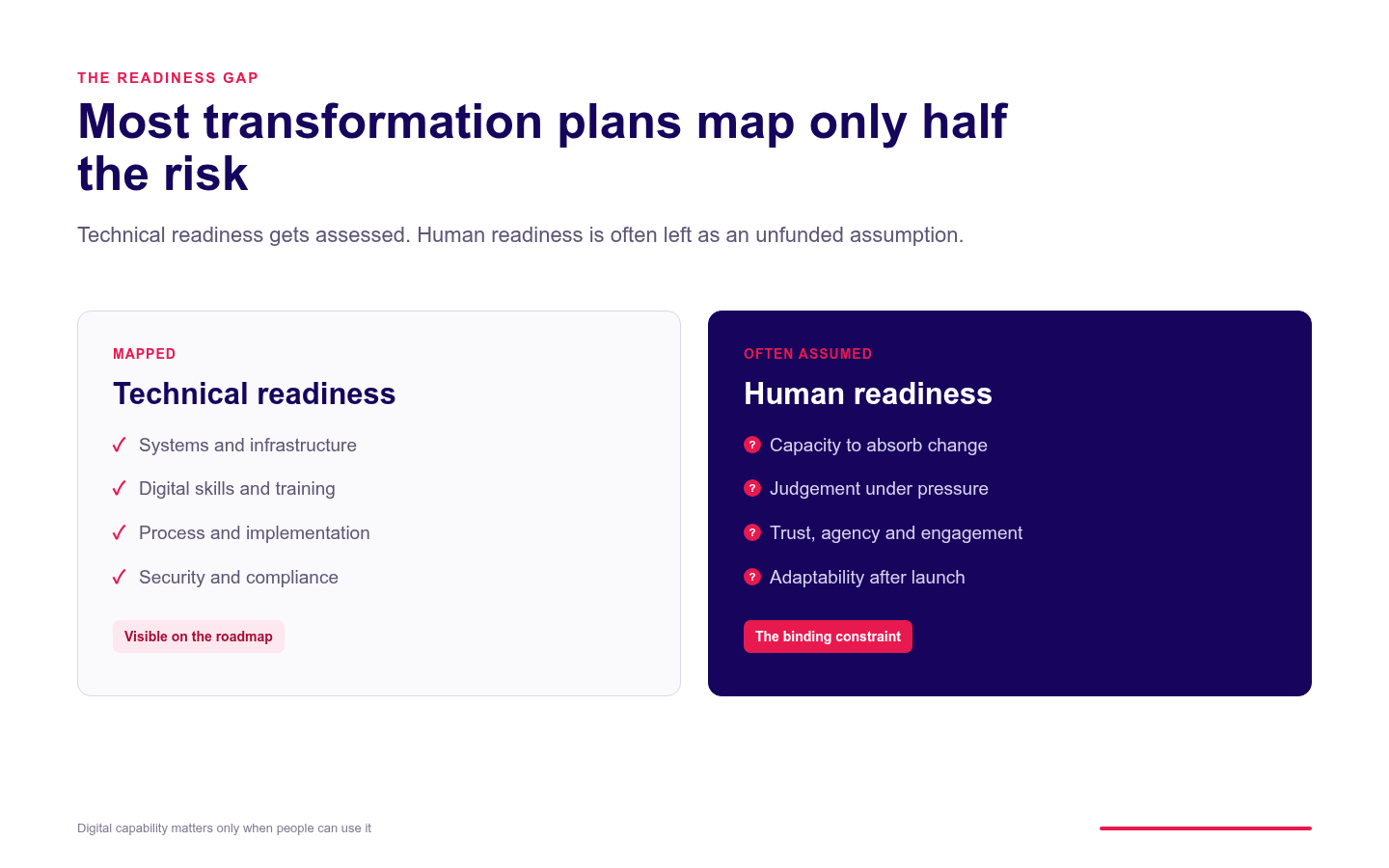
This brings us to the half of readiness most agencies skip. Skills mapping reliably covers technical readiness: the capability needed for systems to run and future solutions to be built. That matters. But human readiness determines whether that technical capability is ever used. It describes how prepared people are to absorb ripple effects, adapt and anticipate change rather than experience it as sustained stress. Compress a set of tasks, as in the call centre examples familiar to most agencies, and someone still performs what is left, at a new intensity. Genuine innovation requires the courage to challenge core assumptions and ask what might not be true tomorrow. Only people equipped to question their own beliefs can do that.
Engagement, not buy-in
The social contract of employment has shifted. In government especially, people join to contribute, not to process transactions. The question is no longer simply, ‘Is my job secure?’ Most of us have quietly accepted that security was always something of an illusion. The question is now, ‘Does the work I do matter, and do I have any say in how it changes?’ This is not generational. The evidence shows it spread across every age group.
At the same time, engagement is eroding, including in places that were reliably strong. Government is one of them. Some popular engagement instruments are not statistically robust; their appeal is that they can produce a flattering score without anyone being meaningfully engaged. The more rigorous measures are showing the dip.
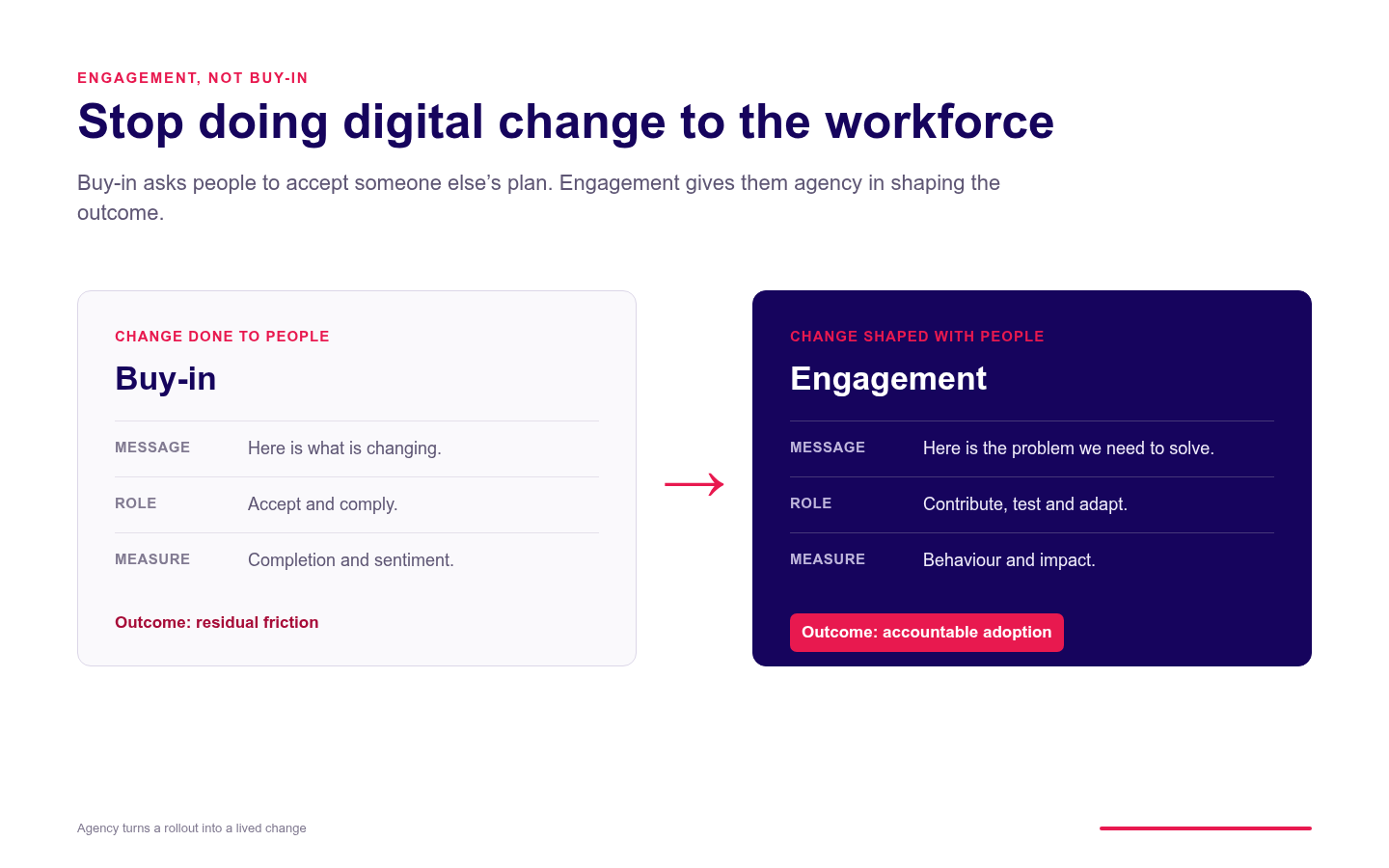
That should concern anyone automating transactional work, because it makes the organisation wholly dependent on an engaged person exercising good judgement. Technology's other effect is that it makes mistakes travel faster, so you need people invested enough to pause before something escalates. This is why I dislike the language of ‘buy-in’. It describes change being done to someone rather than an invitation to shape it. Engagement belongs in the digital roadmap as a strategic dependency, not as a score to be managed.
Redesign work for humans
Four shifts consistently move the result, and none of them require you to buy anything.
Embed the learning. Micro-learning and online modules have their place, but they transfer knowledge. If the goal is changed behaviour under pressure, learning must be connected to real work: workplace projects, peer learning and scenario-based practice that builds memory people can retrieve when the pressure is on.
Treat flexibility as a performance enabler. Not only where people work, but how they work. Designed well, it expands the capacity people have to engage with change rather than merely endure it.
Focus on impact, not tasks. Much of the fear around AI is task-shaped: this thing I do today is going away, so what is left? Tasks will shift, and anyone claiming to know which ones is guessing. Impact is the durable frame, and it is where everybody can still find a place.
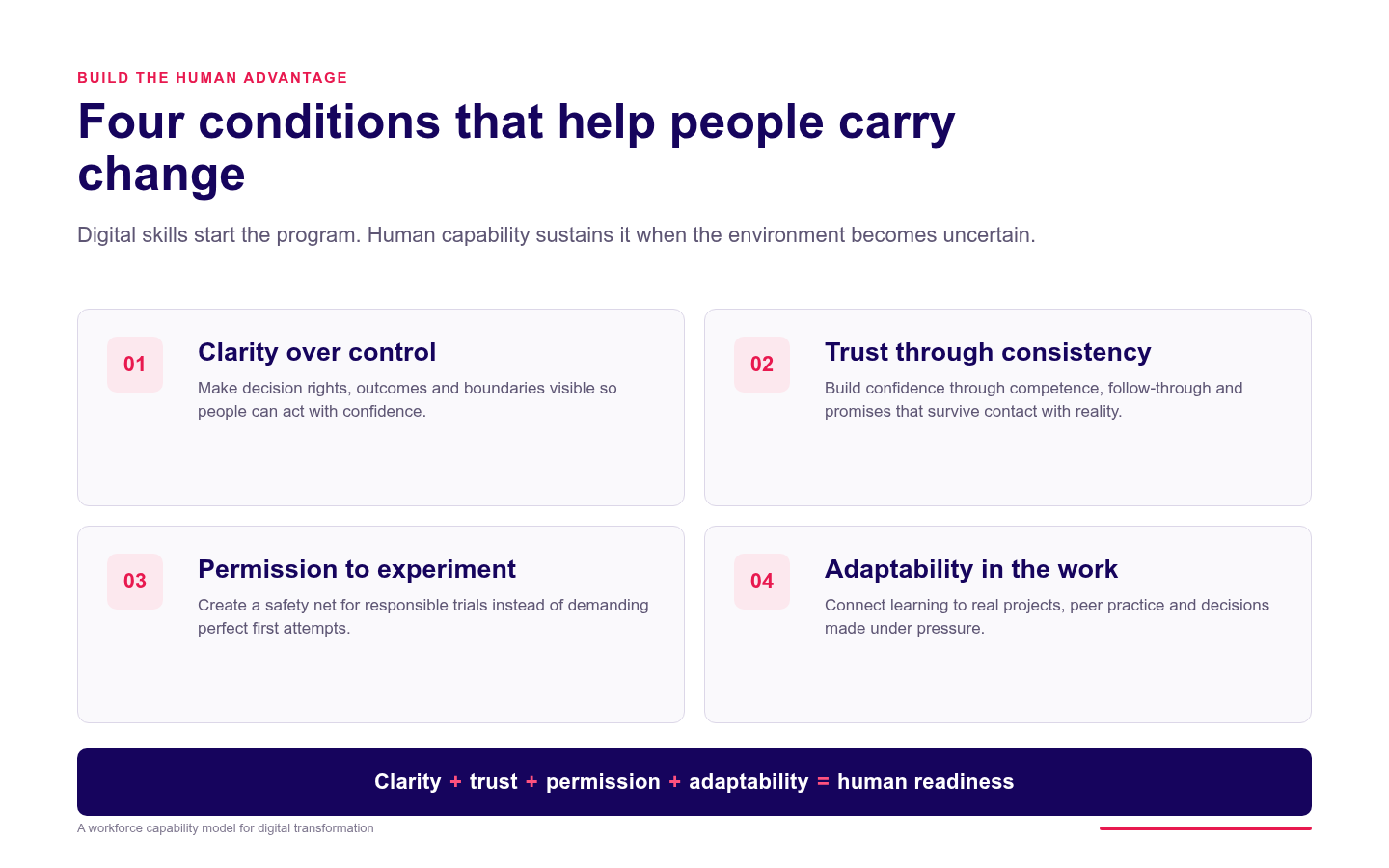
Build the human advantage. Digital skills get a project started; human skills get it finished. At least 70 per cent of digital projects fail, and that is only the share prepared to admit it. Four conditions carry most of the weight: move from control to clarity, since most people making a poor decision believe it is a good one; build trust through competence and consistency, and by not pulling the rug out from under people; grant psychological permission to experiment inside a safety net instead of demanding perfection; and build for adaptability, which humans are genuinely exceptional at when given both the structure and the skills.
On measurement, KPIs are inherently a stick. Objectives and key results at least describe a destination rather than a minimum threshold, and allow both an attainable and a stretch goal. Beyond the mechanics, the answer is simpler than it sounds: talk to people as people, not as functions of an output. Share the strategy and the deliverables, and most will design a genuinely creative way to contribute and hold themselves accountable for it.





Help your peers
Share what you've learned with fellow public servants