
ERP and transformation programs are usually judged on the strength of their technology, timelines, and budgets. Yet in practice, the biggest threat to a program's success is rarely the system itself. It is what happens inside the people who are expected to use it.
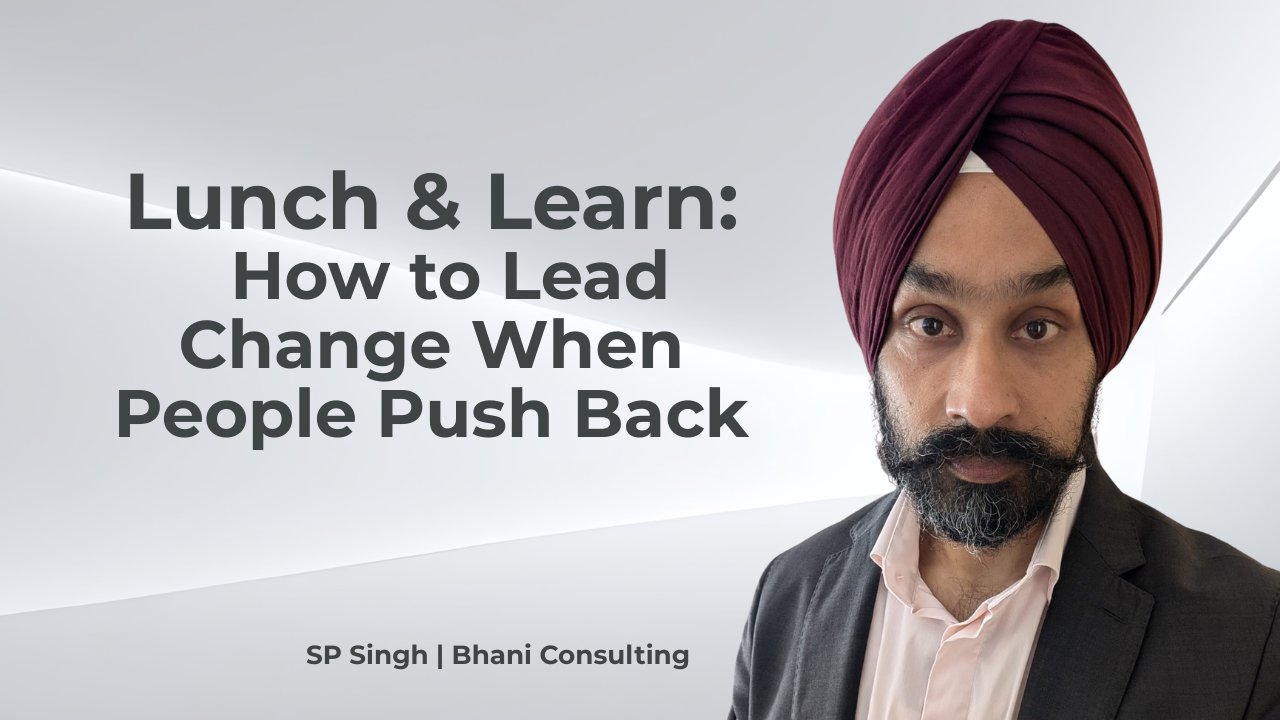
This was the focus of Bhani Consulting's recent Lunch & Learn session, People Don't Resist Change, They Resist Loss, led by transformation advisor SP Singh and delivered in partnership with Aspire Change Management.
The session explored a simple but often overlooked idea: resistance to change is rarely about the change itself. It is a response to loss — of competence, control, identity, or status. When this is not understood, leaders tend to treat resistance as a compliance problem to be managed, rather than a human response to be anticipated. The result is hesitation among teams, disengagement among subject matter experts, and stalled progress that has little to do with whether the tools are working.
A key theme throughout the discussion was the value of understanding the emotional stages people move through during change. Participants were introduced to the 5 Emotional Stages of Change, and how recognising which stage a team or individual is in allows leaders to respond with the right kind of support, rather than applying the same message to everyone regardless of where they stand.
The session also introduced the Influence Pyramid, a framework for directing leadership effort to where it actually shifts outcomes. With limited time and attention, leaders need to distinguish between effort that reassures people and effort that genuinely builds ownership. This was paired with a discussion of the Narrative Reset, a technique used by effective leaders to realign teams around a shared story when momentum starts to slip, and to convert frustration among subject matter experts into a sense of genuine investment in the outcome.
The discussion challenged the assumption that resistance is best addressed with more communication, more directives, or more oversight. In many cases, the greater opportunity lies in understanding why resistance is occurring in the first place, and addressing the underlying loss before it hardens into disengagement.
For public sector leaders, this perspective is particularly relevant as councils and organisations continue to run multi-year ERP and digital transformation programs under pressure to deliver on time and within budget. Anticipating resistance early can help protect both timelines and team morale, and reduce the rework and internal conflict that often follow when adoption is treated as an afterthought.
The session reinforced an important message: successful transformation is not simply a technology outcome. It is a leadership outcome, shaped by how well leaders understand the people they are asking to change.
As transformation programs continue to grow in scale and complexity, the ability to lead through resistance — rather than around it — will become an increasingly important capability for public sector leaders. Understanding the psychology behind resistance can turn friction into ownership, and fatigue into sustained momentum.

Published by
About our partner
Bhani Consulting
At Bhani Consulting, we provide 100% independent and software-agnostic consulting services that take a holistic approach to Business system implementations. Our team is with you every step of the way, whether you're starting from scratch or upgrading existing systems. We are trusted partners who lead from the front and provide support throughout the process.Our proven track record of transforming businesses and achieving growth speaks to our success in streamlining processes and improving the customer experience. We understand the challenges of automating business processes, including systems selection and implementation.
Learn more





Help your peers
Share what you've learned with fellow public servants